
Sales contests and leaderboards, run from the CRM
Set a target, pick the activities that count towards it, and let the leaderboard do the rest. Reps earn medals and diamonds for the work that actually moves deals, and everyone can see where they stand.
✓ No credit card required ✓ 14-day free trial ✓ Cancel anytime
Trusted by over 18,000 users globally





At a Glance
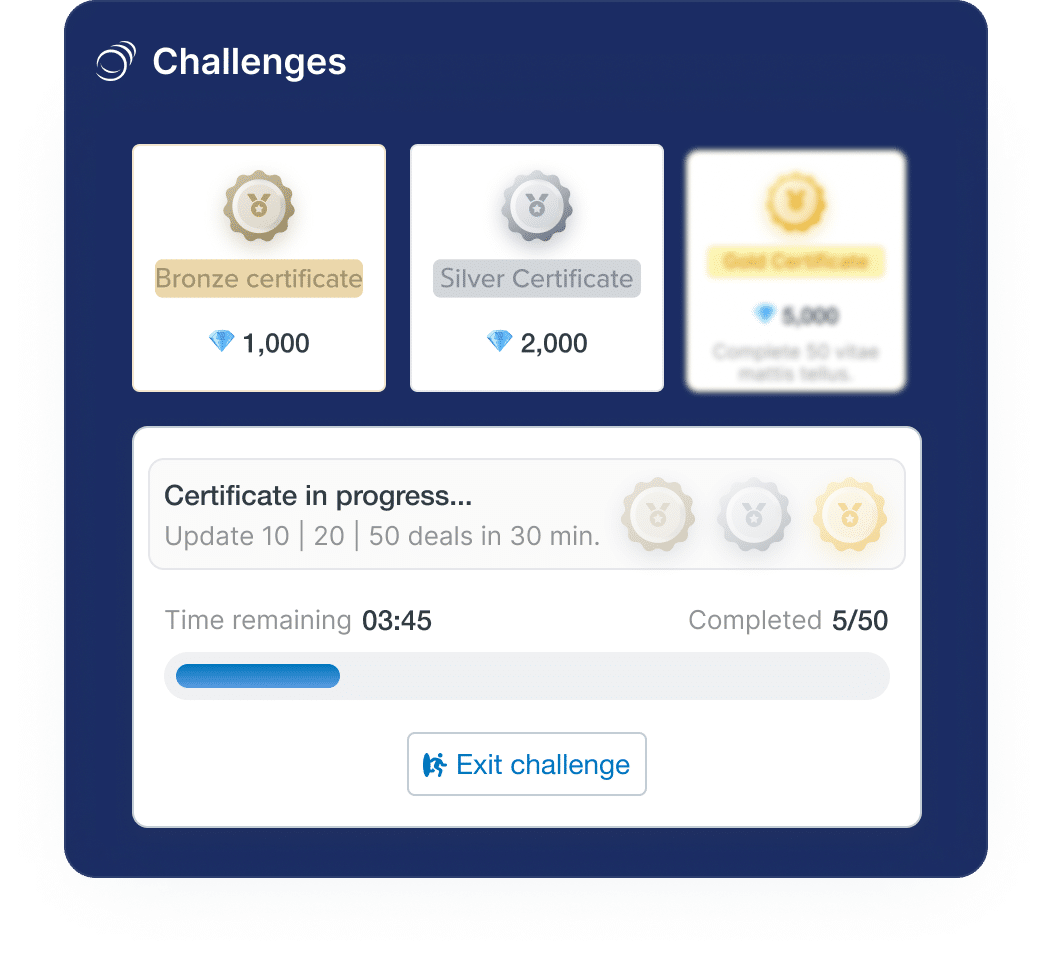
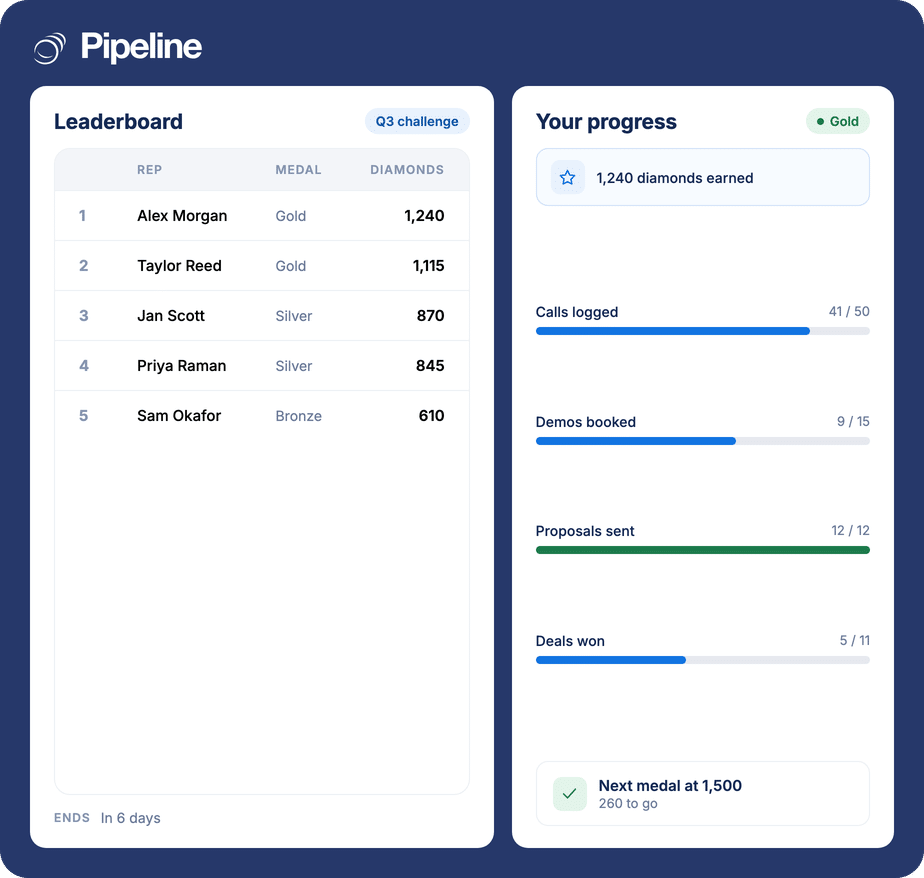
Challenges is sales gamification built into Pipeline CRM. You set a time-boxed contest around the activities that matter, and reps earn diamonds as they complete them. Diamond totals drive leaderboard position, and gold, silver and bronze medals are awarded by how much activity a rep completes before the clock runs out.
Activity targets are easy to set and easy to ignore
Most teams already agree what good activity looks like. The difficulty is keeping it visible once the quarter gets busy.
Nobody knows where they stand
A target announced in January and reviewed in March is not a target, it is a memory. Without a running score there is nothing to react to.
Only the closers get recognised
Recognition that lands only on closed revenue skips the calls and demos that produced it, and skips whoever is having a slow month through no fault of their own.
The contest lives in a spreadsheet
When someone has to update the standings by hand, they stop, and the competition quietly ends before the deadline does.
Pick the activities, set the clock, watch the board
Scoring comes from activity the CRM is already recording, so nobody has to report their own numbers.
Choose what counts
Decide which activities the challenge rewards, and how many of them a rep needs. Higher medal tiers require more activity.
Reps earn diamonds
Completing the tracked items earns diamonds, which accumulate as badges and set a rep’s position on the leaderboard.
Medals settle it
Gold, silver and bronze are awarded on how much was completed before time ran out, so the result is based on effort across the period rather than one lucky week.
Teams big enough to have a middle
Gamification does very little for one person and a lot for a group where most people are neither top nor bottom.
Teams driving activity, not just revenue
When the constraint is calls and demos rather than closing skill, rewarding the input is what changes the output.
Managers running a defined push
A time-boxed contest gives a quarter-end or a new-product launch a focal point that does not need chasing.
Teams onboarding new reps
A new starter who cannot win on revenue yet can still win on activity, which is the behaviour you want to reinforce anyway.
What Challenges covers
Gamification that scores itself from activity already captured in the CRM.
Time-boxed challenges
Contests run to a deadline rather than indefinitely.
Activity-based scoring
Progress comes from completing tracked items, not self-reporting.
Diamonds
Reps accumulate diamonds for completed activity.
Badges
Diamond totals surface as badges on a rep’s profile.
Leaderboard status
More diamonds means a higher position on the board.
Gold, silver and bronze medals
Medal tiers awarded by how much activity was completed.
Escalating tiers
Higher medals require more activity, so the top tier stays worth something.
Live progress tracking
Reps can see how far through a challenge they are at any point.
Team-wide visibility
The standings are visible to the team rather than held by a manager.
Recognition works better than reminders
Every sales manager knows which activities lead to closed deals, and most spend the quarter reminding people to do them. A live scoreboard does that job continuously and without nagging – and it rewards the rep who made forty calls in a bad month, which a revenue-only view never will.
Sales gamification questions
Can’t find what you need? Contact our team.
What is sales gamification?
It is the practice of applying game-like elements – points, levels, leaderboards and rewards – to sales work, so that progress is visible and competitive rather than only reviewed at the end of a period.
In Pipeline CRM that takes the form of Challenges: a time-boxed contest where completing tracked activity earns diamonds, diamonds drive leaderboard position, and medals are awarded by how much was completed.
How do reps earn points?
By completing the activities the challenge is built around. Each completion earns diamonds, which accumulate into badges and set the rep’s place on the leaderboard.
Because the scoring reads activity already recorded in the CRM, nobody has to submit their own numbers and there is no separate scoreboard to maintain.
How do the medals work?
Gold, silver and bronze are awarded based on how much activity a rep completes before the challenge ends. The higher the medal, the more activity it requires.
That tiering is what keeps a contest meaningful for the whole team rather than only the person in first place.
Does a challenge have to be about revenue?
No, and usually it should not be. Challenges are built around activities, which makes them useful precisely when the thing you want more of is calls, demos or proposals rather than closed deals.
Rewarding input also gives newer reps something they can win while they are still ramping.
Can the whole team see the leaderboard?
Yes. Standings are visible rather than held privately by a manager, which is the mechanism that makes a contest self-sustaining.
Individual progress is also visible to the rep, so they can see how far through a challenge they are and what the next medal requires.
Does this replace goals and reporting?
No. Challenges is about motivation over a defined period; goal reporting and dashboards are the permanent measurement layer, and those are available on every plan.
Most teams use both: the goal is the standing expectation, the challenge is the push.
Which plan includes Challenges?
Availability is not listed in the public plan matrix, so the honest answer is to check with us rather than have this page guess.
The pricing page carries the full comparison for everything that is listed, and our team can confirm where Challenges sits for your plan.