
CRM onboarding, setup and team training
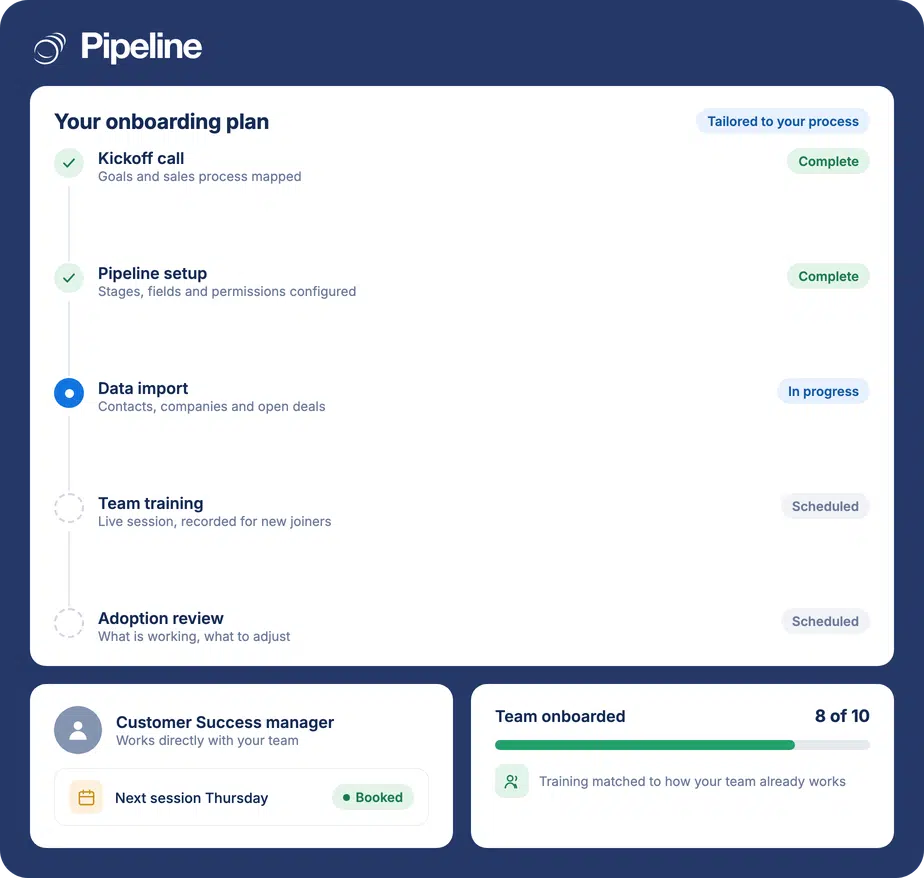
A customer success manager works with your team to configure Pipeline CRM around how you actually sell, move your existing data in, and train each role on the part they will use. Two packages, both starting from a tailored plan.
✓ No credit card required ✓ 14-day free trial ✓ Cancel anytime
Trusted by over 18,000 users globally





At a Glance
Pipeline CRM onboarding is delivered by its customer success team. A manager builds a tailored plan around your workflows and terminology, configures the system to match, handles data migration and setup, and trains each role on what they will actually use. Two packages are available: Standard onboarding starts at $750 and Premium onboarding starts at $1,500.
CRMs fail on adoption, not features
Almost every abandoned CRM was capable of doing the job. What went wrong happened in the first month.
The system gets configured like everyone else’s
A generic setup means the stages, fields and terminology do not match how your team talks about deals, so people quietly keep working the old way.
Training is one session everyone forgets
A single all-hands walkthrough covers everything and lands for nobody, because a sales manager and a new rep need different things from the same tool.
The old data never quite arrives
When migration is left as a task for a busy team, half the history stays in the old system and people keep going back to it.
A plan built around your process, not a checklist
A customer success manager runs this with you rather than handing over documentation.
Understand how you sell
Onboarding specialists take the time to learn your specific workflows, terminology and processes before anything is configured.
Configure and migrate
The system is set up to match that process, and your existing data is migrated in as part of the package rather than left with you.
Train by role, then keep going
Training is tailored so every team member, from a seasoned rep to a new hire, learns the part of the CRM they will actually use.
Teams who cannot afford a slow start
Onboarding support earns its cost where a stalled rollout is expensive or where nobody internally owns the change.
Teams switching from another CRM
There is history to move and habits to change at the same time, which is the combination that most often stalls a migration.
Teams coming off spreadsheets
Moving from spreadsheets means designing the process for the first time, not just re-implementing an old one.
Organisations with several roles to train
When reps, managers and operations all need something different, role-based training beats one long session.
What onboarding covers
Two packages. Both are delivered by the customer success team and both start from a plan tailored to your business.
A dedicated success manager
A Pipeline CRM customer success manager works directly with your team throughout.
A tailored onboarding plan
The plan is built around your business goals rather than a standard script.
Tailored system setup
Pipeline CRM configured to your workflows, terminology and process.
Data migration and setup
Your existing data is moved in as part of the engagement.
Team training and support
Training delivered so each role learns the part they will use.
Role-based approach
Seasoned reps and new hires are trained differently, on purpose.
Adoption focus
The programme is built around user adoption, which is the most common reason CRM rollouts fail.
Standard onboarding
The core package. Starts at $750.
Premium onboarding
The deeper engagement for more complex rollouts. Starts at $1,500.
The first month decides the next three years
A CRM that matches how a team already works gets used. One that does not becomes a reporting chore people route around, and no feature added later fixes that. Onboarding is where that outcome is actually determined, which is why it is run by a person rather than a help centre article.
The Pipeline CRM team’s knowledge, attentiveness, and ability to work with my habits were and are outstanding. They took control of onboarding our agencies with flawless execution.
Charles BeemusSVP Sales Operations, Choice Financial Group
Onboarding questions
Can’t find what you need? Contact our team.
What does the CRM onboarding process look like?
It starts with understanding rather than configuration. A customer success manager works with your team to build a plan around your business goals, and onboarding specialists learn your specific workflows, terminology and processes first.
From there the system is configured to match, your existing data is migrated in, and the team is trained by role. The order matters: configuring before understanding is what produces a CRM nobody recognises.
How much does onboarding cost?
There are two packages. Standard onboarding starts at $750 and Premium onboarding starts at $1,500.
Both are one-off service packages rather than a subscription add-on, and both begin with a tailored plan. Which one fits depends on the complexity of the rollout, so the starting point is a conversation about scope.
Is data migration included?
Data migration and setup is one of the three things an onboarding engagement covers, alongside tailored system setup and team training.
It is part of the paid package rather than a separate free service, which is worth knowing when comparing against vendors who quote migration separately.
Do you train the whole team or just an admin?
The whole team, and deliberately not in one session. Training is tailored so every team member learns what their role actually needs, because a seasoned sales veteran and a new hire want very different things from the same tool.
That role-based approach is aimed squarely at adoption, which is the most common reason a CRM rollout fails.
Will the CRM be set up around how we already work?
That is the intent. Onboarding specialists take the time to understand your specific workflows, terminology and processes, and Pipeline CRM is configured to reflect them.
If you want to keep adjusting that configuration yourself afterwards, custom fields and pipeline stages are editable at any time.
Do we need onboarding to use Pipeline CRM?
No. Pipeline CRM can be set up and run without a paid onboarding engagement, and a free trial does not require one.
Onboarding is worth considering when you are migrating history from another system, when several roles need training at once, or when nobody internally has time to own the rollout.
How long does onboarding take?
It depends on the complexity of the rollout, which is why the engagement starts with a tailored plan rather than a fixed timetable.
The published customer example above describes working with the team over a period of months to integrate Pipeline CRM into an existing workflow, so a larger multi-team rollout should be planned in weeks rather than days.