The 10 best manufacturing CRMs of 2026.
A ranked guide to the CRM platforms small and mid-sized manufacturers actually use, evaluated on ERP integration depth, long-cycle deal tracking, distributor and dealer management, and fit for 25 to 500 employee shops. For the distribution side of the business, see the companion ranking of the best CRM for wholesalers and distributors.

At a glance: The best manufacturing CRMs in 2026 are Salesforce Manufacturing Cloud (best for enterprise manufacturers with dedicated CRM admins), Pipeline CRM (best for SMB manufacturers 25 to 500 employees who want a sales-first CRM that pairs with existing ERP), HubSpot CRM (best for manufacturers needing sales and marketing unified), Microsoft Dynamics 365 Sales (best for existing Dynamics ERP customers), and NetSuite CRM (best for NetSuite ERP customers). Mid-market manufacturers get the best fit-to-price from Pipeline CRM, Pipedrive, and Insightly at under $50 per user per month (billed annually). Choose based on existing ERP, team size, and whether you need sales-only CRM or projects plus CRM bundled.
The 10 best manufacturing CRM platforms at a glance
The following table ranks the top CRM platforms for manufacturers in 2026 based on ERP integration depth, long-cycle deal tracking, distributor and dealer management, sales-team fit, and pricing transparency. Each CRM is matched to a specific manufacturing scenario so readers can filter by fit rather than an arbitrary overall ranking.
| Rank | CRM | Best For | Starting Price | G2 Rating | ERP Fit |
|---|---|---|---|---|---|
| 1 | Salesforce Manufacturing Cloud | Enterprise manufacturers with dedicated CRM admins | Custom enterprise pricing (starts around $165/user/mo on Sales Cloud Enterprise base) | 4.4/5 (Sales Cloud, 23,000+ reviews) | Industry-specific |
| 2 | Pipeline CRM | SMB manufacturers (25 to 500 employees) wanting sales-first CRM next to existing ERP | $25/user/mo (Start, billed annually) | 4.4/5 (933 reviews) | QuickBooks native; Zapier to NetSuite/Dynamics |
| 3 | HubSpot CRM | Growing manufacturers needing sales + marketing automation | Free tier / $20/seat/mo (Starter) | 4.4/5 (11,000+ reviews) | Partner integrations |
| 4 | Microsoft Dynamics 365 Sales | Manufacturers already on Microsoft Dynamics ERP | $65/user/mo (Professional) | 3.8/5 (1,500+ reviews) | Native (Dynamics ERP) |
| 5 | NetSuite CRM | Manufacturers running Oracle NetSuite ERP | Custom enterprise pricing (bundled with NetSuite) | 4.0/5 (3,000+ reviews) | Native (NetSuite ERP) |
| 6 | Pipedrive | Manufacturers wanting visual kanban pipelines and broad integrations | $14/user/mo (Lite, billed annually) | 4.3/5 (2,500+ reviews) | Zapier; add-on connectors |
| 7 | Zoho CRM | Budget manufacturers in the Zoho One ecosystem | $14/user/mo (Standard) | 4.1/5 (2,700+ reviews) | Native to Zoho Inventory |
| 8 | Insightly | Manufacturers wanting projects + CRM with manufacturing templates | $29/user/mo (Plus, billed annually) | 4.2/5 (900+ reviews) | QuickBooks, Xero, partner ERPs |
| 9 | SugarCRM | Mid-market manufacturers wanting open-source flexibility or on-prem option | $80/user/mo (Sell) | 3.9/5 (700+ reviews) | Customizable connectors |
| 10 | Creatio | Manufacturers wanting low-code workflow customization and BPM-grade process automation | $25/user/mo (Growth) | 4.7/5 (250+ reviews) | Open API; low-code connectors |
Ratings and review counts verified from G2 as of June 2026. Pricing pulled from each vendor’s public pricing page or verified competitor profile data. All prices are per user per month unless otherwise noted. Pipeline CRM prices are billed annually. Salesforce Manufacturing Cloud and NetSuite CRM use custom enterprise pricing; ranges shown reflect typical SMB-to-mid-market quotes.
What should manufacturers look for in a CRM?
Manufacturers looking for a CRM should evaluate seven specific criteria that determine whether the tool will fit a manufacturing sales motion, not a generic SaaS sales motion. Manufacturers sell on long cycles, often through dealers or distributors, with quotes that hand off to an existing ERP for production scheduling and invoicing. A CRM that ignores this reality becomes shelfware within 12 months. The criteria below separate manufacturing-fit CRMs from generic sales tools.
- ERP integration depth. Manufacturers usually already run NetSuite, Microsoft Dynamics, QuickBooks, Acumatica, SAP, or Infor. A manufacturing CRM should integrate bidirectionally with the ERP for accounts, products, orders, and invoices. Native integration beats Zapier; Zapier beats CSV imports; manual entry is a non-starter.
- Long-cycle deal tracking. Manufacturing sales cycles run 3 to 12 months for B2B distribution and 6 to 24 months for capital equipment. The CRM should support multi-stage pipelines with stage-gated milestones, deal-aging indicators, and reminders that survive sales rep turnover.
- Distributor and dealer relationship management. Many manufacturers sell through dealers or distributors. The CRM should support partner records, lead-routing rules between manufacturer reps and channel partners, and visibility into the dealer’s deal pipeline without forcing the dealer into the manufacturer’s CRM.
- Quote-to-order workflow. Manufacturing deals close with a quote that triggers production scheduling. The CRM should generate quotes (CPQ light or full), capture eSignature, and hand the won deal cleanly to the ERP for invoicing and production planning. Manual re-keying between CRM and ERP is the most common adoption killer.
- Account-based pipelines. Manufacturers sell to buying committees inside accounts, not single contacts. The CRM should support multi-stakeholder account records, role-based contact tracking (procurement vs engineering vs operations), and account-level pipeline reporting in addition to deal-level pipeline reporting.
- Territory and rep management. Manufacturer reps cover geographic territories with route-based selling. The CRM should support Map Views, territory assignment, lead routing by ZIP or region, and commission tracking. For field reps, an offline-capable mobile app is non-negotiable.
- Sales analytics and forecasting. Manufacturing CFOs need weighted forecasts by stage, by territory, and by product line. Win-rate trends by industry vertical, by lead source, and by rep separate a CRM that informs production planning from one that gets ignored.
The 10 manufacturing CRMs below are ranked by how well they deliver on these seven criteria for manufacturers of 25 to 500 employees, not by overall feature count or enterprise prestige.
What are the best manufacturing CRM platforms in 2026?
The best manufacturing CRM platforms in 2026 split into three camps: enterprise industry-specific platforms (Salesforce Manufacturing Cloud), ERP-native CRMs that pair with an existing back-office system (Microsoft Dynamics 365 Sales, NetSuite CRM), and sales-first CRMs that complement rather than replace the ERP (Pipeline CRM, Pipedrive, HubSpot, Zoho, Insightly, SugarCRM, Creatio). The right choice depends on existing ERP, team size, and whether you need a sales-only tool or a sales-and-projects bundle. Here are the 10 best options for SMB-to-mid-market manufacturers, ranked by fit.
1. Salesforce Manufacturing Cloud: Best for enterprise manufacturers with dedicated CRM admins

Overview: Salesforce Manufacturing Cloud is the category-leading industry-specific CRM for manufacturers. Built on top of Salesforce Sales Cloud Enterprise, it adds manufacturing-vertical features like Sales Agreements (long-term contract tracking), Account-Based Forecasting (rolling forecast at the account level), and Partner Lifecycle Management (channel partner workflows). It is used by global manufacturers including Schneider Electric, Hitachi, and Lennox International, and it leads the industry on brand recognition for “manufacturing CRM” queries.
Why it made the list
Salesforce Manufacturing Cloud earns the #1 slot because it is the most feature-complete CRM purpose-built for manufacturing sales motions. The Sales Agreement object handles multi-year purchase agreements with rolling volume commitments better than any generic CRM. Partner Lifecycle Management is the strongest dealer-and-distributor solution in the market. And the Salesforce platform itself integrates with virtually every ERP, MES, and supply chain system through the AppExchange.
Key features for manufacturers
- Sales Agreements for long-term volume commitments with rolling forecast tracking
- Account-Based Forecasting with run-rate vs new-business splits
- Partner Lifecycle Management for dealer and distributor workflows
- Agentforce AI agents for quoting, order management, and customer service
- Industry-specific data model with Manufacturing Account, Sales Agreement, and Order Forecast objects
- Deep AppExchange integrations with SAP, NetSuite, Oracle, Dynamics, and most MES platforms
Pricing
Salesforce Manufacturing Cloud uses custom enterprise pricing. The Sales Cloud Enterprise base license starts at $165 per user per month (billed annually). The Manufacturing Cloud add-on typically lands in the $50 to $150 per user per month range on top of the base. Total cost for a 50-rep manufacturer typically starts around $250 per user per month plus mandatory Premier Success Plan (30 percent of license fees) for phone support. Implementation is typically 6 to 12 months and requires either internal Salesforce admins or a Salesforce partner.
G2 rating
Salesforce Manufacturing Cloud is tracked under Salesforce Sales Cloud’s G2 listing, which scores 4.4/5 stars on 23,000+ reviews. Frequently praised for capability ceiling and ecosystem; criticized for setup complexity, cost, and admin overhead.
Best for
Large manufacturers (200+ sales reps) with dedicated CRM admins, complex partner ecosystems requiring Partner Lifecycle Management, long-term sales agreements with rolling commitments, and budget for $250+ per user per month all-in cost.
Not great for
Small and mid-sized manufacturers (under 100 employees) without a dedicated Salesforce admin: the platform’s capability ceiling becomes a complexity tax for smaller teams. Also weaker for manufacturers running QuickBooks or smaller ERPs where the Salesforce-to-ERP integration burden outweighs the manufacturing-specific feature set.
Dig deeper: our Salesforce vs Pipeline CRM side-by-side comparison breaks down pricing at 5, 10, and 25 seats, feature parity for SMB manufacturers, and the support cost gap.
2. Pipeline CRM: Best for SMB manufacturers who want sales-first CRM that pairs with existing ERP

Overview: Pipeline CRM is a sales CRM that offers quote-to-order pipeline tracking, deal management, and custom fields for production specs for SMB manufacturers, with native QuickBooks Online integration plus an open API and Zapier to pair with an existing ERP. For manufacturers, its core appeal is that it does not try to replace the ERP. It sits next to NetSuite, Microsoft Dynamics, QuickBooks, Acumatica, or whatever back-office system manufacturers already run, handling only what those systems handle badly: the sales pipeline. Over 18,000 users run their pipelines on Pipeline CRM, and it scores 9.2/10 for quality of support on G2, the highest rating of any CRM in this listicle.
Why it made the list
Pipeline CRM earns the #2 slot because it solves the specific problem most SMB-to-mid-market manufacturers face: their ERP handles production and invoicing well but tracks sales pipeline badly, and Salesforce Manufacturing Cloud is overkill at $250+ per user per month all-in. Pipeline CRM at $25 to $49 per user per month (billed annually) delivers a clean sales-focused pipeline with long-cycle deal tracking, US-based live chat support (9.2/10 on G2), Map Views for territory reps, and a native QuickBooks integration that handles the most common manufacturer-ERP pairing. For manufacturers running NetSuite or Microsoft Dynamics, Pipeline CRM integrates via Zapier or middleware like Celigo.
Key features for manufacturers
- Visual sales pipeline with long-cycle stage tracking and deal-aging indicators
- Map Views for territory and route-based selling (included on all plans)
- Native QuickBooks integration for the most common manufacturer-ERP pairing
- Email drip campaigns, eSign, and lead forms on the Grow plan with no add-ons
- Account-based reporting with multi-stakeholder contact records
- US-based live chat support included on every plan (G2: 9.2/10, highest in this set)
- 20-year track record (originally PipelineDeals, 2006) with manufacturing customers including industrial distributors and B2B manufacturers
Pricing
Pipeline CRM uses transparent 3-tier pricing: Start at $25 per user per month, Develop at $33 per user per month, and Grow at $49 per user per month (all billed annually). Enterprise is custom-quoted. No seat minimum, no mandatory onboarding fees, no hidden add-ons. Onboarding training is available from $750 (Standard) or $1,500 (Premium) if you want guided setup.
G2 rating
4.4/5 stars based on 933 verified reviews. Support score: 9.2/10 (the highest in this listicle and 1.0 points above the manufacturing-CRM category average of 8.2). Frequently praised for US-based human support, ease of setup (9.0/10), and clean visual pipeline; criticized only for narrower integration breadth than Pipedrive or HubSpot.
Best for
SMB and mid-market manufacturers (25 to 500 employees) running QuickBooks, NetSuite, Microsoft Dynamics, Acumatica, or other ERPs that handle production but lack a sales pipeline. Particularly strong for manufacturers with 5 to 50 outside sales reps covering territories, where Map Views and the offline-capable mobile app drive adoption.
Not great for
Large manufacturers (500+ employees, 100+ reps) with complex multi-year sales agreements and partner channel programs that need Salesforce Manufacturing Cloud’s Sales Agreement object or Partner Lifecycle Management module. Also less of a fit for manufacturers that want CRM and ERP unified on one platform (NetSuite CRM or Dynamics 365 Sales fit that profile better).
Dig deeper: see the Pipeline CRM manufacturing CRM industry page for vertical-specific features, or read manufacturer case studies for real-world rollout examples.
3. HubSpot CRM: Best for growing manufacturers who need sales + marketing automation

Overview: HubSpot is a customer platform that bundles CRM, marketing automation, sales tools, and customer service on a single contact record. For manufacturers building inbound demand (case studies, technical content, dealer locator pages), HubSpot’s marketing-and-sales unification is the strongest argument. The free CRM tier is genuinely free and supports unlimited contacts, but the Sales Hub paid tiers (Starter, Professional, Enterprise) unlock the features manufacturers actually need: deal stages, sales forecasting, sequences, and reporting.
Why it made the list
HubSpot earns the #3 slot because for growing manufacturers (50 to 200 employees) building an inbound marketing engine alongside the sales pipeline, the unified contact record is genuinely valuable. A lead that downloads a CAD spec sheet, opens three follow-up emails, and attends a virtual demo can be scored and routed without stitching together Marketo, Salesforce, and a service desk. The HubSpot AppMarketplace also has manufacturer-specific templates and integrations with most ERPs via paid connectors.
Key features for manufacturers
- Free CRM tier with unlimited contacts and 2 free Sales Hub users
- Unified contact record across marketing, sales, and service hubs
- Strong inbound marketing tooling (forms, email, landing pages, blog)
- Sales sequences, deal stages, and weighted forecasting on Sales Hub
- Manufacturer-specific templates in the App Marketplace
- Paid ERP connectors via partner apps (NetSuite, Dynamics, SAP)
Pricing
HubSpot uses tiered pricing: free CRM (unlimited contacts, 2 free Sales Hub users), Starter at $20 per seat per month, Professional at $90 per seat per month plus a mandatory $1,500 onboarding fee, and Enterprise at $150 per seat per month plus a $3,500 onboarding fee. Paid tiers carry seat minimums (Pro requires 5 seats; Enterprise requires 10). Costs add up fast: a 10-rep Pro deployment costs $9,000 per year in seats alone plus $1,500 onboarding.
G2 rating
4.4/5 stars based on 11,000+ verified reviews across HubSpot Sales Hub. Frequently praised for the unified platform and inbound tools; criticized for Pro and Enterprise pricing escalation, seat minimums, and the mandatory onboarding fees.
Best for
Growing manufacturers (50 to 200 employees) building an inbound marketing engine alongside the sales pipeline. Particularly strong for manufacturers selling direct-to-business (not through dealers) where lead-nurture sequences and content marketing drive most of the funnel.
Not great for
Manufacturers selling primarily through dealer or distributor channels where partner workflows matter more than inbound marketing. Also costly for manufacturers with 25+ reps on the Sales Hub Pro plan, where Pipeline CRM Grow at $49 per user per month (billed annually) delivers the sales features at half the cost.
Dig deeper: our HubSpot vs Pipeline CRM side-by-side comparison shows the cost crossover at 5, 10, and 25 seats.
4. Microsoft Dynamics 365 Sales: Best for manufacturers already on Dynamics 365 ERP

Overview: Microsoft Dynamics 365 Sales is the CRM module of the broader Dynamics 365 business application suite. For manufacturers already running Dynamics 365 Finance, Supply Chain Management, or Business Central, Dynamics 365 Sales offers the deepest native CRM-to-ERP integration on the market. Power BI is included for reporting, Microsoft Teams is integrated for collaboration, and Microsoft Copilot adds AI-assisted email drafting and meeting summaries.
Why it made the list
Microsoft Dynamics 365 Sales earns the #4 slot for one reason: if you already pay for Dynamics 365 ERP, layering on the Sales module is dramatically more integrated than bolting any other CRM onto Dynamics. Quote-to-cash flows from CRM to ERP without middleware, customer master data stays unified, and Power BI dashboards reach across both data sets. For non-Dynamics shops, the value proposition collapses: standalone Dynamics 365 Sales is enterprise-priced and lacks the SMB-friendly UX of Pipeline CRM or Pipedrive.
Key features for manufacturers
- Native bidirectional integration with Dynamics 365 Finance, Supply Chain, and Business Central
- Microsoft Copilot for AI-assisted email and meeting summaries
- Power BI dashboards included on all Dynamics 365 tiers
- Microsoft Teams integration for collaboration on deals
- Forecasting with multi-currency support for global manufacturers
- Sales accelerator with prioritized work queues for inside sales teams
Pricing
Microsoft Dynamics 365 Sales pricing: Professional at $65 per user per month, Enterprise at $105 per user per month, Premium at $150 per user per month, and Relationship Sales at $135 per user per month (all billed annually, requires a Microsoft Cloud Solution Provider or direct EA agreement). Implementation cost is typically $50,000 to $250,000 for a 50-user mid-market manufacturer, plus ongoing Microsoft partner fees.
G2 rating
3.8/5 stars based on 1,500+ reviews on G2. Frequently praised for the Microsoft ecosystem integration and Power BI reporting; criticized for setup complexity, UI inconsistency across modules, and the Microsoft partner gatekeeping for implementations.
Best for
Mid-market and enterprise manufacturers (100+ employees) already running Microsoft Dynamics 365 ERP. Particularly strong for global manufacturers with multi-entity operations where Dynamics’s multi-currency, multi-language, and multi-legal-entity features matter.
Not great for
SMB manufacturers (under 100 employees) and any manufacturer not already on Dynamics 365 ERP: standalone Dynamics 365 Sales loses on price, setup speed, and rep adoption to sales-native CRMs like Pipeline CRM or Pipedrive.
5. NetSuite CRM: Best for manufacturers running Oracle NetSuite ERP

Overview: NetSuite CRM is a thin sales and marketing layer on top of Oracle NetSuite ERP. For manufacturers already running NetSuite for production planning, inventory, financials, and order management, NetSuite CRM eliminates the CRM-to-ERP integration burden entirely. The CRM and ERP share one data model: a NetSuite customer record carries sales opportunities, quotes, orders, invoices, and support cases without sync or middleware.
Why it made the list
NetSuite CRM earns the #5 slot because for NetSuite-running manufacturers, no other CRM can match the unified data model. Quote-to-cash flows are instantaneous; there is no synchronization lag, no field mapping, no schema drift. The trade-off is that NetSuite CRM is a thin sales layer compared to sales-native CRMs: pipeline visualization, forecasting workflows, and rep productivity tools all trail Pipeline CRM, Pipedrive, and HubSpot.
Key features for manufacturers
- Native unified data model with NetSuite ERP (no integration, no sync)
- Real-time order-to-cash visibility from opportunity to invoice
- Partner Relationship Management module for dealer and distributor workflows
- Marketing automation with email campaigns and lead nurturing (separate SuiteSocial module)
- Mobile app for field reps with offline access
- Account-based selling with multi-contact, multi-stakeholder records
Pricing
NetSuite CRM uses custom enterprise pricing. NetSuite itself starts around $999 per month base plus $99 per user per month minimum, scaling rapidly with module add-ons. NetSuite CRM as a standalone purchase is uncommon: most manufacturers buy it bundled with NetSuite ERP. Total cost for a 50-rep manufacturer typically lands in the $130 to $200 per user per month range when allocated across the full NetSuite bundle.
G2 rating
4.0/5 stars based on 3,000+ reviews on G2 (NetSuite overall, which includes the CRM module). Frequently praised for unified data and reporting; criticized for UI dating, customization complexity, and total cost.
Best for
Mid-market and enterprise manufacturers (100+ employees) already running NetSuite ERP. Particularly strong for manufacturers that need real-time order-to-cash visibility and that already have NetSuite implementation expertise on staff.
Not great for
SMB manufacturers and any manufacturer not on NetSuite: as a standalone CRM, NetSuite CRM loses on UX, sales-native features, and price to Pipeline CRM, Pipedrive, and HubSpot. Also a poor fit if your sales team prioritizes a clean visual pipeline; NetSuite’s pipeline UI is functional but dated.
6. Pipedrive: Best for manufacturers wanting visual kanban pipelines and broad integrations
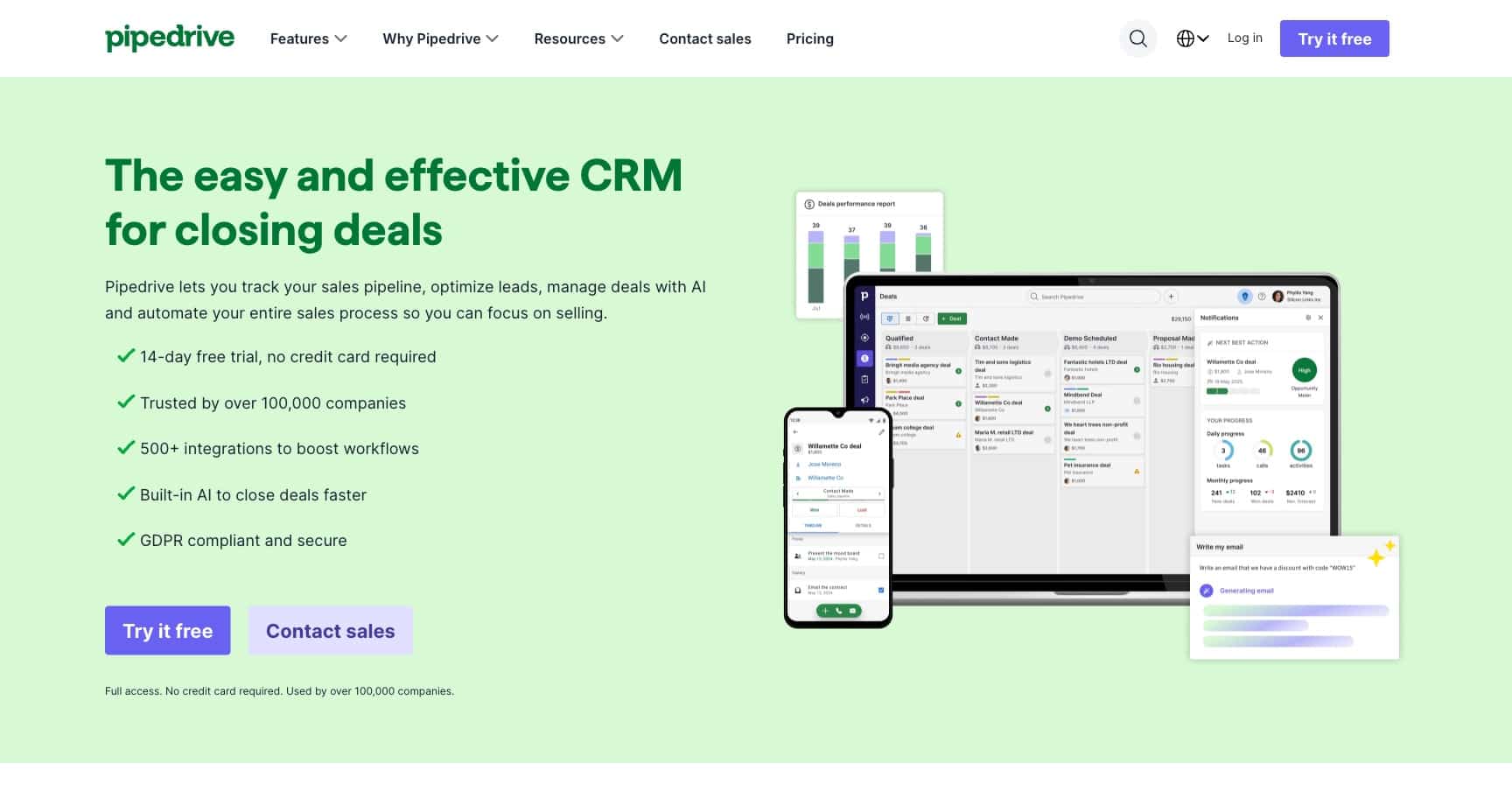
Overview: Pipedrive is a category-leading sales CRM with the broadest brand recognition for visual-pipeline CRM in the SMB segment. While not manufacturing-specific, Pipedrive’s strength for manufacturers is its 400+ integration marketplace (the largest in SMB CRM) and the lowest entry-tier price in this set at $14 per user per month (Lite, billed annually). Manufacturers with simple sales motions and limited ERP integration needs often run Pipedrive as a low-cost pipeline tracker.
Why it made the list
Pipedrive earns the #6 slot because for manufacturers with limited budget and simple ERP integration needs (Zapier-based, not deep), Pipedrive delivers a clean visual pipeline at the lowest entry price. It also has manufacturer-specific templates available in the marketplace and integrates with most major ERPs through paid Pipedrive Marketplace apps or Zapier. Pipedrive is a credible alternative to Pipeline CRM for manufacturers prioritizing the visual kanban UX above all else.
Key features for manufacturers
- Visual drag-and-drop pipeline with customizable stages
- Activity-based selling workflow with tasks attached to deals
- 400+ integrations including QuickBooks, Slack, Zoom, DocuSign, and Zapier
- Mobile app with offline access and call logging
- Lead scoring and routing on Premium and above
- Manufacturer-specific templates in the Pipedrive marketplace
Pricing
Pipedrive restructured to four tiers in early 2026: Lite at $14 per user per month, Growth at $39 per user per month, Premium (most popular) at $59 per user per month, and Ultimate at $79 per user per month (all billed annually). Add-ons like LeadBooster ($32.50 per month), Projects ($6.67 per month), Campaigns ($13.33 per month), and Web Visitors ($41 per month) are priced per company but add up quickly if you need them.
G2 rating
4.3/5 stars based on 2,500+ verified reviews. Support score: 8.3/10. Frequently praised for pipeline UI and integrations; criticized for support responsiveness (Pipeline CRM scores 0.9 points higher) and pricing that escalates at higher tiers.
Best for
SMB manufacturers (under 100 employees) with simple sales motions, limited ERP integration needs, and budget under $20 per user per month for the entry tier. Particularly strong for manufacturers that prioritize the broadest third-party integration library.
Not great for
Manufacturers selling through dealer or distributor channels (Pipedrive lacks dedicated partner workflow tools) or running long-cycle capital equipment sales where Pipeline CRM’s account-based pipeline reporting and stage-aging tools provide more depth. Also weaker on support quality for manufacturers that call support often.
Dig deeper: our Pipedrive vs Pipeline CRM side-by-side comparison breaks down pricing at 5, 10, and 25 seats and feature parity for manufacturers.
7. Zoho CRM: Best for budget manufacturers already in the Zoho One ecosystem

Overview: Zoho CRM is the CRM module of the broader Zoho One business suite, which bundles 45+ applications including Zoho Inventory (lightweight inventory management), Zoho Books (accounting), Zoho Desk (support), and Zoho Campaigns (marketing). For budget-conscious manufacturers running multiple Zoho apps, the Zoho One bundle delivers CRM at a marginal cost. Standalone Zoho CRM is also one of the cheapest sales CRMs at $14 per user per month (Standard tier).
Why it made the list
Zoho CRM earns the #7 slot because for manufacturers already running Zoho Inventory and Zoho Books for back-office, the native integration with Zoho CRM eliminates the integration overhead that plagues most SMB CRM rollouts. Zoho Inventory specifically handles SKU-level inventory tracking, multi-warehouse, and basic manufacturing bills-of-materials (BOMs) for small manufacturers (under 50 employees), and the CRM connects directly to it.
Key features for manufacturers
- Native integration with Zoho Inventory (SKUs, warehouses, basic BOMs) and Zoho Books
- Zoho One bundle pricing for the full 45-app suite
- Customizable modules and layouts (Canvas design studio)
- Zia AI assistant for lead scoring, deal predictions, and email sentiment
- Multi-currency, multi-language, and global edition features
- Mobile app with offline access
Pricing
Zoho CRM tiers: Standard at $14 per user per month, Professional at $23 per user per month, Enterprise at $40 per user per month, Ultimate at $52 per user per month (all billed annually). Zoho One bundle (CRM + 44 other apps) is $37 per user per month (Flexible User) or $90 per employee per month (All Employee). For small manufacturers running multiple Zoho apps, the bundle is dramatically cheaper than buying each separately.
G2 rating
4.1/5 stars based on 2,700+ verified reviews. Frequently praised for value-per-dollar and customization; criticized for UI complexity, support response times, and the learning curve across modules.
Best for
Small manufacturers (10 to 50 employees) running Zoho Inventory or Zoho Books for back-office and looking for sales CRM at marginal incremental cost. Particularly strong for small manufacturers in international markets where Zoho’s multi-currency and multi-language features matter.
Not great for
Manufacturers not already in the Zoho ecosystem: Zoho CRM as a standalone purchase has UX friction and weaker support than Pipeline CRM or Pipedrive at similar price points. Also weaker for manufacturers running NetSuite, Dynamics, or QuickBooks who would not benefit from the Zoho One bundle savings.
Dig deeper: our Zoho CRM vs Pipeline CRM side-by-side comparison shows the cost crossover and support quality gap.
8. Insightly: Best for manufacturers wanting projects + CRM with manufacturing templates

Overview: Insightly is a mid-market CRM that bundles sales pipeline management with native project management on a unified platform. For manufacturers that close a deal and then deliver a custom product or installation project, Insightly’s projects-and-CRM combo eliminates the need for a separate PM tool. Insightly has an explicit manufacturing-vertical positioning with templates for industrial manufacturers, equipment suppliers, and B2B distributors.
Why it made the list
Insightly earns the #8 slot because for manufacturers that sell custom configurations or installation projects, the post-close handoff from sales to project delivery is a real workflow gap. Insightly handles the handoff inside one platform. Pipeline CRM’s Grow plan now includes a native project management module (launched May 2026) that addresses the same workflow, but Insightly has a longer track record on the projects-and-CRM combo and stronger manufacturing-specific templates.
Key features for manufacturers
- Native project management inside the same platform as the CRM
- Manufacturing-specific workflow templates
- Custom objects for SKUs, BOMs, and equipment configurations
- Workflow automation with multi-step approvals
- Integration with QuickBooks, Xero, and partner ERPs
- Mobile app with offline access
Pricing
Insightly tiers (CRM only): Plus at $29 per user per month, Professional at $49 per user per month, Enterprise at $99 per user per month (all billed annually). Insightly All-in-One bundles (CRM + Marketing + Service) cost more per seat. Mandatory onboarding starts at $1,500 for Plus and scales up to $15,000+ for Enterprise.
G2 rating
4.2/5 stars based on 900+ verified reviews. Frequently praised for the projects-and-CRM combo and customization depth; criticized for onboarding cost, learning curve, and weaker sales-pipeline UI than sales-native CRMs.
Best for
Mid-market manufacturers (50 to 200 employees) that sell custom configurations or installation projects and want the post-close handoff inside one platform. Particularly strong for industrial equipment manufacturers and B2B distributors with project-based deliveries.
Not great for
Manufacturers with simple sales motions that do not need project management (Pipeline CRM or Pipedrive deliver cleaner sales-pipeline UX without the project complexity). Also costly for small manufacturers (under 25 employees) where the onboarding fee and per-user cost outpace the value of the bundled PM.
9. SugarCRM: Best for mid-market manufacturers wanting open-source flexibility or on-prem deployment

Overview: SugarCRM has a long manufacturing-vertical track record dating to its open-source origins in the early 2000s. While now a commercial cloud platform, SugarCRM still offers on-premises deployment (rare in 2026) for manufacturers with data residency or compliance requirements that block cloud-only CRMs. SugarCRM Sell (the sales-focused product) competes against Salesforce in the mid-market with a heavily customizable workflow engine.
Why it made the list
SugarCRM earns the #9 slot because it remains one of the few credible CRMs offering on-prem deployment, which matters for manufacturers in defense, aerospace, regulated industries, or jurisdictions with data sovereignty requirements. The customization depth also lets technical manufacturers build CRM workflows that mirror their existing ERP processes without compromise. Trade-off: implementation requires technical resources and the UX is dated relative to cloud-native sales CRMs.
Key features for manufacturers
- On-premises deployment option (rare in 2026 CRM landscape)
- Heavily customizable workflow engine
- SugarBPM for process automation
- Custom modules for SKUs, BOMs, and manufacturing-specific entities
- Integration with most major ERPs through Sugar Integrate (formerly Cloud Sherpas)
- Mobile app with offline access
Pricing
SugarCRM tiers: Sell Essentials at $19 per user per month (limited features), Sell Standard at $59 per user per month, Sell Advanced at $85 per user per month, Sell Premier at $135 per user per month (all billed annually). On-prem licensing and Sugar Enterprise pricing are custom-quoted. Most mid-market manufacturer deployments land in the $80 to $135 per user per month range.
G2 rating
3.9/5 stars based on 700+ verified reviews. Frequently praised for customization depth and on-prem option; criticized for dated UI, learning curve, and smaller US install base than Salesforce or HubSpot.
Best for
Mid-market manufacturers (100 to 500 employees) with data sovereignty or compliance requirements that mandate on-prem CRM, or with technical resources to customize a heavily configurable platform. Particularly strong for defense and aerospace manufacturers.
Not great for
SMB manufacturers and any manufacturer without dedicated technical resources to customize and maintain the platform. Also a poor fit for manufacturers that want clean sales-native UX without configuration overhead.
10. Creatio: Best for manufacturers wanting low-code workflow customization and BPM-grade process automation

Overview: Creatio is a CRM-and-BPM platform that pairs sales tools with a low-code workflow engine strong enough to model end-to-end manufacturing sales processes. For manufacturers with complex multi-step approvals (quote approvals across engineering, finance, and operations) or non-standard sales motions, Creatio’s BPM engine handles workflows that generic CRMs cannot. Creatio publishes industry-specific templates including manufacturing, distribution, and B2B services.
Why it made the list
Creatio earns the #10 slot because for manufacturers with workflow complexity beyond standard pipeline stages (multi-department approval flows, conditional quote routing, multi-currency contract handling), the BPM engine is more powerful than most CRMs in this list. Trade-off: implementation skews enterprise; SMB onboarding requires either internal BPM expertise or a Creatio partner. G2 rating is the highest in this list (4.7/5) but on a much smaller review base.
Key features for manufacturers
- Low-code BPM workflow engine for end-to-end process automation
- Industry-specific templates including manufacturing
- Open API and low-code integration builder for ERP connections
- Custom case management and approval flows
- Mobile app with offline access
- AI-powered lead scoring and next-best-action recommendations
Pricing
Creatio Sales tiers: Growth at $25 per user per month, Enterprise at $55 per user per month, Unlimited at $85 per user per month (all billed annually). BPM module and Studio Pro are licensed separately. Implementation typically starts at $25,000 for SMB manufacturer deployments and scales with workflow complexity.
G2 rating
4.7/5 stars based on 250+ verified reviews. Highest rating in this listicle but on a much smaller review base. Frequently praised for workflow customization and BPM depth; criticized for implementation cost and smaller US install base.
Best for
Mid-market manufacturers (100 to 500 employees) with complex multi-step approval workflows or non-standard sales motions that require BPM-grade customization. Particularly strong for manufacturers needing quote-approval workflows across multiple departments.
Not great for
SMB manufacturers with standard sales motions where Pipeline CRM, Pipedrive, or HubSpot deliver faster setup at lower cost. Also a poor fit for manufacturers without internal BPM expertise or budget for partner-led implementation.
Which manufacturing CRM is best for which type of manufacturer?
Which manufacturing CRM is best depends on company size, existing ERP, sales motion (direct vs channel), and whether you need projects bundled with the CRM. The breakdown below maps the ranked list above to specific manufacturer profiles.
Best manufacturing CRM for 25 to 200 employee manufacturers
Pipeline CRM, HubSpot, and Pipedrive lead for SMB manufacturers. Pipeline CRM is the strongest fit when you already run an ERP (QuickBooks, NetSuite, Dynamics, Acumatica) and need sales-first CRM that pairs with it. HubSpot fits when you also need marketing automation. Pipedrive is the budget pick at $14 per user per month entry.
Best manufacturing CRM for 200 to 1000 employee manufacturers
Salesforce Manufacturing Cloud, Microsoft Dynamics 365 Sales, and Pipeline CRM lead for mid-market manufacturers. Salesforce Manufacturing Cloud is the most feature-complete but requires dedicated admins. Dynamics 365 Sales fits when you already pay for Dynamics ERP. Pipeline CRM remains a credible option at this scale for manufacturers that prioritize rep adoption and support quality over enterprise feature ceiling.
Best manufacturing CRM for distributors and dealer-network manufacturers
Pipeline CRM, Salesforce Manufacturing Cloud, and Insightly are the strongest for manufacturers selling through dealer or distributor channels. Salesforce Manufacturing Cloud’s Partner Lifecycle Management is the most complete dealer-portal solution. Pipeline CRM handles distributor records, partner contact routing, and dealer-deal visibility at SMB pricing. Insightly bundles project management for installation-driven dealer relationships.
Best manufacturing CRM for direct-to-business manufacturers
Pipeline CRM, Pipedrive, and HubSpot lead for manufacturers selling direct to end customers without intermediary dealers. Pipeline CRM’s account-based pipeline reporting handles multi-stakeholder buying committees common in direct B2B sales.
Best manufacturing CRM for NetSuite users
NetSuite CRM is the native pick for NetSuite ERP customers because of the unified data model. Pipeline CRM is a strong sales-native alternative when NetSuite CRM’s pipeline UX feels too thin: connect Pipeline CRM to NetSuite via Celigo, Boomi, or Zapier middleware.
Best manufacturing CRM for Microsoft Dynamics ERP users
Microsoft Dynamics 365 Sales is the native pick for Dynamics ERP customers. Pipeline CRM is a sales-native alternative when Dynamics 365 Sales’s enterprise pricing and UX complexity are not worth the integration depth for smaller manufacturers.
Best manufacturing CRM for QuickBooks Manufacturing users
Pipeline CRM has native QuickBooks integration and is the strongest sales-first CRM for QuickBooks-running manufacturers. Pipedrive integrates via Zapier or marketplace apps. HubSpot integrates via a paid partner connector.
Best manufacturing CRM with built-in project management
Insightly and Pipeline CRM (Grow plan, native PM module since May 2026) bundle project management with the CRM. Insightly has a longer PM track record; Pipeline CRM’s native module is newer but priced lower at $49 per user per month (Grow, billed annually) versus Insightly’s $49 per user per month (Professional CRM only, PM module costs extra).
What CRM features matter most for manufacturing sales teams?
The CRM features that matter most for manufacturing sales teams are the ones that handle the unique parts of manufacturing sales motions: long cycles, dealer channels, ERP handoffs, and account-based selling. Generic sales-CRM features like email tracking and contact records are table stakes; the features below separate manufacturing-fit CRMs from generic sales tools.
- ERP integration depth. Pipeline CRM ships native QuickBooks integration, the most common ERP for SMB manufacturers. NetSuite CRM and Microsoft Dynamics 365 Sales integrate natively with their respective ERPs. HubSpot, Pipedrive, Zoho, and Insightly use paid partner connectors or Zapier middleware. Manual CSV export is a non-starter for serious manufacturer use.
- Long-cycle deal tracking with stage aging. Manufacturer sales cycles of 3 to 24 months require deal-aging indicators that flag deals stuck at any stage. Pipeline CRM, Pipedrive, HubSpot, and Salesforce all support stage-aging. NetSuite CRM and Dynamics 365 Sales support it but with less visual clarity.
- Account-based pipeline reporting. Manufacturers sell to buying committees (procurement, engineering, operations, finance). Account-level reports that aggregate deals, contacts, and activity across the full account are essential. Salesforce Manufacturing Cloud, Pipeline CRM, HubSpot, and Insightly handle this well. Pipedrive’s account-level reporting is weaker.
- Quote generation and eSign. Closing a manufacturer deal requires a quote that converts to a purchase order in the ERP. Pipeline CRM Grow includes native eSign and lead forms with no add-ons. Pipedrive offers eSign on Premium. HubSpot requires a DocuSign integration. Salesforce Manufacturing Cloud uses Salesforce CPQ (separately priced).
- Distributor and dealer portal. Manufacturers selling through dealers need a portal where dealers can submit leads, see commission status, and submit orders. Salesforce Manufacturing Cloud’s Partner Lifecycle Management is the most complete. NetSuite has Partner Relationship Management. Pipeline CRM and Pipedrive handle distributor records natively but do not provide a dedicated dealer-facing portal (handle via shared deal access).
- Territory and Map Views. Manufacturer field reps cover geographic territories. Pipeline CRM is the only sales CRM in this list to include Map Views with route planning on every plan. Salesforce Maps is an add-on. Pipedrive Web Visitors is a separate paid add-on.
- Forecasting and Power BI / native reporting. Manufacturing CFOs need weighted forecasts by stage, by territory, by product line, and by industry vertical. Salesforce, Dynamics 365 Sales, and NetSuite have the most mature forecasting. Pipeline CRM, Pipedrive, and HubSpot all deliver credible weighted-pipeline forecasting at SMB pricing.
- Calling and email integration. Inside sales teams need integrated calling (native or via Aircall, RingCentral, Dialpad). Pipeline CRM, Pipedrive, HubSpot, and Salesforce support it via third-party connectors. NetSuite and Dynamics integrate calling via Microsoft Teams Phone or Cisco.
How do I choose the right CRM for my manufacturing business?
Choosing the right CRM for your manufacturing business starts with two questions: what ERP do you already run, and how complex is your sales motion? Match the CRM to the existing back-office system first, then layer in sales-team fit. The framework below maps common manufacturer profiles to the right CRM.
Use this decision framework:
- 200+ reps, dedicated admins, and complex partner channel programs? → Salesforce Manufacturing Cloud (Enterprise or above) with mandatory Premier Success Plan.
- 25 to 500 employees, already on QuickBooks, NetSuite, Dynamics, or Acumatica, want sales-first CRM that pairs with the ERP? → Pipeline CRM (Develop or Grow tier, $33 to $49 per user per month billed annually).
- 50 to 200 employees, building an inbound marketing engine alongside sales? → HubSpot Sales Hub (plan budget for Professional at $90 per seat per month plus the $1,500 onboarding fee).
- Already pay for Microsoft Dynamics 365 ERP? → Microsoft Dynamics 365 Sales (Professional or Enterprise tier).
- Already run Oracle NetSuite for ERP? → NetSuite CRM (purchased bundled with NetSuite licensing).
- SMB manufacturer with simple sales motion and tight budget? → Pipedrive (Lite at $14 per user per month billed annually) or Pipeline CRM Start at $25 per user per month for stronger support.
- Small manufacturer already running Zoho One for back-office? → Zoho CRM bundled in Zoho One ($37 per user per month Flexible User).
- Manufacturer that sells custom configurations and needs projects + CRM bundled? → Insightly Professional ($49 per user per month billed annually) or Pipeline CRM Grow ($49 per user per month billed annually, native PM module since May 2026).
- Manufacturer with on-prem deployment requirement or data sovereignty? → SugarCRM (Sell Standard or Advanced tier).
- Manufacturer with complex multi-department approval workflows? → Creatio (Sales Enterprise tier with BPM module).
Two practical tips before you commit:
- Pilot with 3 to 5 reps for 30 days, including at least one field rep. Manufacturer sales motions vary dramatically between inside sales (quotes, distributor coordination) and outside field sales (Map Views, offline mobile). Pick a pilot mix that covers both. If field reps revert to spreadsheets during the pilot, the CRM will fail at rollout.
- Test the ERP integration during the trial. Most failed manufacturer-CRM rollouts trace to ERP integration friction. Before you commit, send 10 real customer records from your ERP to the CRM and 10 quotes from the CRM to the ERP. If either round trip requires manual cleanup, the integration is not production-ready.
Frequently asked questions about manufacturing CRM software
What is the best CRM for manufacturers in 2026?
The best CRM for manufacturers in 2026 depends on company size and existing ERP. Salesforce Manufacturing Cloud is the most feature-complete for enterprise manufacturers (200+ reps) with dedicated CRM admins. Pipeline CRM is the strongest fit for SMB-to-mid-market manufacturers (25 to 500 employees) running QuickBooks, NetSuite, Microsoft Dynamics, or Acumatica that want a sales-first CRM that pairs with the existing ERP. HubSpot fits growing manufacturers also building inbound marketing. Microsoft Dynamics 365 Sales and NetSuite CRM are the right picks if you already pay for the corresponding ERP.
What’s the difference between a manufacturing CRM and a general-purpose CRM?
A manufacturing CRM handles the specific parts of manufacturer sales motions that generic CRMs ignore: long sales cycles (3 to 24 months), dealer and distributor channel management, quote-to-order handoff to the ERP, account-based selling to buying committees, and territory or route-based field sales. A general-purpose CRM treats every deal as a single contact, a single linear pipeline, and a single closed-won event. Salesforce Manufacturing Cloud is the only CRM in this list with an industry-specific data model. Pipeline CRM and others handle manufacturing motions through configuration rather than industry-specific objects.
Do I need a manufacturing-specific CRM or can a general CRM handle manufacturing sales?
For 90 percent of SMB-to-mid-market manufacturers (25 to 500 employees), a configurable general CRM like Pipeline CRM, Pipedrive, or HubSpot handles manufacturing sales motions well at a fraction of the cost of Salesforce Manufacturing Cloud. The configurability of pipelines, custom fields, and integrations covers long cycles, distributor records, and account-based selling. Industry-specific CRMs become necessary when you have complex multi-year Sales Agreements (Salesforce Manufacturing Cloud’s Sales Agreement object) or formal Partner Lifecycle Management requirements (dealer portals with commission visibility, lead-routing rules, performance scorecards).
How much does a manufacturing CRM cost?
Manufacturing CRM pricing in 2026 ranges from $14 per user per month (Pipedrive Lite, billed annually) at the entry end up to $250+ per user per month all-in for Salesforce Manufacturing Cloud Enterprise. Most SMB-to-mid-market manufacturers land between $25 and $99 per user per month. Pipeline CRM starts at $25 per user per month (Start, billed annually), $33 for Develop, and $49 for Grow. NetSuite CRM and Microsoft Dynamics 365 Sales are typically bundled with the corresponding ERP at $65 to $200 per user per month total. Factor in mandatory onboarding fees on most enterprise tiers and partner-led implementation costs for Salesforce, Dynamics, NetSuite, and Creatio.
Which manufacturing CRM integrates with QuickBooks?
Pipeline CRM ships native QuickBooks integration and is the strongest sales-first CRM for QuickBooks-running manufacturers. Pipedrive integrates with QuickBooks via Zapier or marketplace apps. HubSpot integrates via a paid partner connector (HubSpot QuickBooks Online integration). Insightly integrates with QuickBooks via a built-in connector. SugarCRM and Creatio integrate via custom connectors. Salesforce Manufacturing Cloud, Dynamics 365 Sales, and NetSuite CRM are oriented toward larger ERPs and require partner-built QuickBooks connectors that add complexity.
Which manufacturing CRM works with NetSuite or Microsoft Dynamics?
NetSuite CRM is the native pick for NetSuite ERP customers because of the unified data model with no integration overhead. Microsoft Dynamics 365 Sales is the native pick for Dynamics ERP customers. Pipeline CRM integrates with both NetSuite and Dynamics via Celigo, Boomi, or Zapier middleware, which is the typical alternative when the native CRM’s UX is too thin for your sales team. Salesforce integrates with NetSuite and Dynamics through paid AppExchange connectors.
What’s the best CRM for a small (25 to 100 employee) manufacturer?
The best CRM for a small manufacturer (25 to 100 employees) is Pipeline CRM for teams that already run QuickBooks, NetSuite, Microsoft Dynamics, or Acumatica and want sales-first CRM that pairs with the existing ERP. Pricing starts at $25 per user per month (Start tier, billed annually) with no seat minimums. Pipedrive is a credible budget alternative at $14 per user per month entry. HubSpot fits when marketing automation matters as much as sales. Salesforce Manufacturing Cloud is overkill at this scale.
Can a manufacturing CRM replace my ERP?
No. A manufacturing CRM cannot replace an ERP. The two systems handle different jobs: a CRM tracks the sales pipeline (leads, deals, accounts, contacts, quotes), and an ERP handles production, inventory, supply chain, finance, and invoicing. NetSuite CRM and Microsoft Dynamics 365 Sales blur the line by living inside the same platform as their respective ERPs, but the underlying capability split is the same. Most successful manufacturer CRM rollouts pair a sales-native CRM (Pipeline CRM, Pipedrive, HubSpot) with the existing ERP rather than trying to consolidate everything in one tool.
Which manufacturing CRM is best for managing dealers and distributors?
Salesforce Manufacturing Cloud has the most complete dealer and distributor management with Partner Lifecycle Management for channel partner workflows, dealer portals, and commission visibility. NetSuite CRM has Partner Relationship Management with a similar feature set. For SMB-to-mid-market manufacturers without enterprise budget, Pipeline CRM handles distributor records, partner-routing rules, and dealer-deal visibility at $33 to $49 per user per month (billed annually) without a dedicated dealer portal. Insightly bundles project management for installation-driven dealer relationships.
How long does it take to implement a manufacturing CRM?
Implementation time for a manufacturing CRM ranges from 2 weeks (Pipeline CRM, Pipedrive, HubSpot Starter for a 5-rep team) to 12 months (Salesforce Manufacturing Cloud with Sales Agreements, NetSuite CRM bundled with NetSuite ERP, Dynamics 365 Sales with custom workflows). Sales-native CRMs at the SMB end (Pipeline CRM, Pipedrive, HubSpot, Zoho) typically deploy in 2 to 4 weeks including data migration. Enterprise platforms with industry-specific data models (Salesforce Manufacturing Cloud) and ERP-native CRMs (NetSuite, Dynamics) require 3 to 12 months with partner-led implementation. Plan onboarding budget proportional to implementation time: $0 to $1,500 for SMB tools, $25,000 to $250,000+ for enterprise platforms.