What’s the secret to a winning construction sales pitch?
The competition for new customers in the construction business is aggressive and cutthroat. Customers today are educated, demanding, and price-conscious. If you want to nail your construction sales pitch and win new customers, it starts with construction lead management.
We’ll show you how Pipeline CRM can help you improve your construction sales pitch, better manage your construction leads, and ultimately, win more construction bids.
How Pipeline CRM’s Construction Users Leads Quality Impacts Sales Pitches
Let’s take a look at the data. According to Startup Bonsai:
- 53% of marketers spend at least half of their budget on lead generation
- Nurtured leads produce 20% more sales opportunities
- Nurtured leads generate 50% more sales at 33% lower costs
This is all great news. How is any of this a problem?
In the ‘How to create sales workflows that close deals 3x faster’ blog, we broke down the reality of most construction sales pipelines:
- Only 3% of your prospects are ready to buy right now
- 37% have potential but need nurturing
- 60% are unqualified and won’t buy
That means the majority of your lead spend is going toward construction prospects who will never convert — or aren’t ready to yet. The difference between a pitch that lands and one that doesn’t often comes down to whether you’re talking to the right person at the right time.
That’s a sorting problem. And it’s exactly what Pipeline CRM’s construction CRM is built to solve.
Our lead status tracking lets you tag and move prospects through stages from first contact to close, so unqualified leads don’t crowd out the ones ready to move. Priority lists surface the contacts that need action right now — deals closing with no next task set, leads no one has contacted in the last seven days. And the Home tab gives every rep a daily agenda so finding the 3% isn’t something they have to figure out from scratch each morning.
Before you can nail a construction sales pitch, you need to know who you’re pitching. Pipeline CRM makes sure you’re always talking to the right prospect at the right moment.
Construction Sales Process: The Anatomy of a (Successful) Sales Pitch

The Structure of a Construction Sales Pitch
A successful construction sales pitch isn’t improvised — it’s built on what you already know about your prospect before you walk in the door. That preparation depends on five things being true.
1. You know what your prospects want. Every construction prospect has a different priority — fastest turnaround, lowest cost, least disruption. When that information lives in your CRM against each deal record, you walk into every pitch speaking to what actually matters to them, not a generic version of what you assume they want.
2. You’ve qualified your prospects. Not every lead deserves a full pitch. It’s smart to have them go through a lead quality measurement process before pursuing. Pipeline CRM’s deal stages and lead status tracking let you move prospects through a defined qualification process, so by the time you’re preparing a pitch, you already know they’re worth contacting.
3. You’ve avoided predatory prospects. Some prospects will waste your time with no intention of buying. A complete record of every interaction of calls, emails, and meetings lets you spot those patterns early and cut loose the prospects going nowhere before they drain your team’s time.
4. You know which prospects need to be closed or nurtured. A prospect ready to sign needs a different conversation than one still comparing options. Knowing exactly where each prospect sits in the decision process means your pitch is calibrated to their reality, not your assumptions.
5. Your construction sales pipeline has the precise workflows you need to win more deals. A good pitch doesn’t end when you leave the room. What happens next — the follow-up, the next touchpoint — determines whether you win the deal. That needs to be systematic, not left to memory.
Pipeline CRM’s sales workflow automation handles the next stages and actions every time you contact a lead. This way, so nothing falls through the cracks after the conversation.
When those five things are in place, here’s the pitch framework that works:
- The prospect’s problem or dilemma
- Specific and relevant examples of what happens when the problem goes unresolved
- Your solution
- Case studies showing how you’ve solved it before
- About your company
Examples of a Construction Sales Pitch
A strong construction sales pitch references the prospect’s own words back to them. It shows you were listening, that you understand what’s at stake, and that you’ve thought about their specific situation — not just sent a generic proposal. Here’s what that looks like in practice:
Hi [Prospect name],
When we spoke on [date], you mentioned three things keeping you up at night. I want to address each one directly.
Project delays. You need this project finished within 13 months — no exceptions. Miss that deadline and the financial consequences compound fast. We’ve built our entire project management process around protecting timelines, and we have a track record to back it up.
Cost overruns. You’ve already seen prices jump 33% compared to your last roofing project. That’s real, and we’re not going to pretend otherwise. What we can do is show you exactly how we control costs at every stage — and where we’ve found savings for clients in the same position.
Site compliance. Your previous contractor left you with OSHA violations and a mess to clean up. Every subcontractor we work with is vetted, certified, and held to the same standards we hold ourselves to. That’s not negotiable on our end.
Each of these is solvable. I’d like to walk you through how we’d approach your project specifically — and show you what we’ve delivered for clients facing the same pressures.
Are you available [date and time] for a 30-minute call?
[Your name]
Automating Your Construction Sales Pitch on Pipeline CRM (Construction Follow-Up Email Templates)
A pitch is only as strong as its follow-up. In the construction industry, where 60% of leads are unqualified and another 37% need nurturing, you cannot afford to let follow-ups slip through the cracks.
Instead of manually typing emails, use Pipeline CRM to deploy these three templates based on where your prospect sits in the sales funnel.
1. The “Risk” Follow-up (Automated Workflow)
- Best for: Prospects who have gone quiet after the initial pitch.
- Where it lives in Pipeline CRM: Save this in Email Templates and trigger it via Workflows. Set a rule: if Deal Stage = “Pitch Sent” and no activity for 48 hours, send “Worst-Case Scenario.”
Subject: The cost of a 24-month delay (Story of ABC Corp)
Hi [First_Name],
One of our suppliers recently shared a story about ABC Corp. They were facing the exact same challenges we discussed — specifically the 13-month deadline.
There was just one difference: they procrastinated. Their project was delayed by 24 months, leading to a 317% cost overrun.
Based on what we’ve discussed, I propose we focus on three things to avoid this:
- Meeting the 13-month deadline by focusing on necessities.
- Preventing cost overruns via strict financial controls
- Prioritizing realistic expectations to avoid “nice-to-have” bloat.
Should we lock in the schedule?
2. The “Proof” Nurture (Email Campaign)
- Best for: Prospects who are price-conscious or need more evidence to trust your team.
- Where it lives in Pipeline CRM: Use Pipeline CRM’s email campaigns feature. Filter your leads by the tag #Price-Sensitive and bulk-send this case study to your entire “Nurture” segment.
Subject: Case Study: How XYZ Inc. came in $253K under budget
Hi [First_Name],
I wanted to share how we handled a roofing project for XYZ Inc. that mirrors your current time constraints.
They were facing a $334K monthly loss if they missed their deadline. We instituted strict financial controls at every stage of the project to track every cost.
The results: we finished 1.5 months early and identified $2.3 million in savings across their upcoming projects.
“When Stacy, your PM, told me you could dig us out of the hole, I laughed. Four months later, our project is actually profitable.” — Alton James, XYZ Inc.
3. The “Trust” Closer (One-Click Template)
- Best for: The final touchpoint or “About Us” intro to seal the deal.
- Where it lives in Pipeline CRM: Save this as a Global Email Template. Your reps can pull it up directly from a deal record during or immediately after a call for a five-second send.
Subject: Our guarantee: on time and under budget
[First_Name],
We don’t just promise results — we guarantee them. If we manage your project from start to finish and don’t come in on time and under budget, we’ll pay you 25% of the project price.
Our team is among the top 4% of contractors in North America. Every worker is certified and trained to our standards. Our products come backed by:
- A 50-year product warranty
- A 10-year workmanship warranty
- A limited lifetime warranty on siding
I’ve attached our team’s certifications to this email for your records. Looking forward to getting started.
Closing the Loop with Pipeline CRM
By housing these construction follow-up email templates within Pipeline CRM, your sales pitch stops being a one-time event and becomes a consistent, repeatable engine. Whether it’s a worst-case reminder triggered automatically when a deal goes quiet or a case study sent to a price-sensitive segment, the right message hits the right lead at the right time — without your reps having to remember to send it.
How Pipeline CRM Transforms Your Construction Sales Game
Pipeline CRM helps companies like yours decrease time-to-close, increase productivity by 50% or more, and boost sales by as much as 10x. Don’t take our word for it; let us show you how Pipeline CRM can help you attract, win, and retain customers.
Effortlessly Find Promising, High-Quality Prospects
Which prospects get your attention?
This is an important question. If you spend your time with 60% of prospects unwilling or unable to buy, any construction sales pitch you present will fail. On the other hand, if you spend time with the 37% of prospects who have a need but aren’t yet ready to buy, your construction sales pitch will also fail.
What does this mean then?
Your salespeople need to spend the majority of their time closing deals. They need to spend their time with the 3% of prospects who are willing and able to buy. That’s great, but who are these people, and how do you find them? Your will CRM tell you.
If you’re in construction sales, you know customers want a few things:
- The best contractor their money can buy
- The best service for their money
- The lowest price for their project
- The fastest turnaround/least disruptions for their project
This is helpful information; if you add these details to Pipeline CRM, you can use these data to segment and disqualify your prospects. This is how you optimize your construction sales pipeline and close more sales.
Pro tip: This guide explains how to measure lead quality, allowing you to focus more on promising prospects.
Foster Effective Lead Nurturing
What about lead nurturing? The same thing applies here.
If your prospects respond to content that outlines why your company is the best, you can tailor your offers around that. If they’re looking for the lowest-price contractor (and you want to cater to that), you can segment your prospects that way. Allow your prospects to self-identify.
This is why good documentation – using your CRM – is important. As prospects make their way through your construction sales pipeline, you’ll find you’re able to determine several things:
- Whether you need to close or nurture your prospects
- The anatomy of a sales pitch and closing your prospects
- How to nurture your sales prospects
Now you know how to find and nurture promising leads. The next step is creating a successful construction sales pitch.
How Rainier Custom Homes Cut Their Sales Cycle in Half with Pipeline CRM
Rainier Custom Homes is a family-owned construction business based in Seattle that has been building custom homes in Washington for over 30 years.
When CEO Steve Hettema joined, the team was using BuilderTrend — a construction-specific CRM that functioned more as an internal project management tool than a sales system. Leads weren’t being nurtured, deals weren’t moving, and there was no consistent process to take a prospect from first contact to signed contract.
After testing several construction CRMs and finding them expensive and too similar to what he was already using, Hettema switched to Pipeline CRM.
He built a three-stage sales process — Discovery, Pre-construction, and Build — using separate pipelines for each phase, with custom fields, automated tasks, and email templates mapped to every stage. When a new lead entered the pipeline, a sequence of automated follow-ups fired automatically: appointment scheduling, personalized emails, reminders for on-site visits. Nothing fell through the cracks because nothing was left to memory.
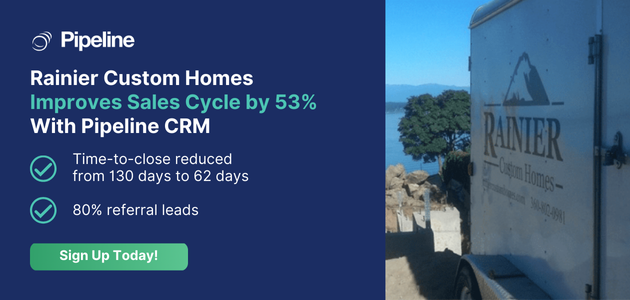
The results: Rainier Custom Homes reduced their average sales cycle from 130 days to 62 — a 53% improvement. And because the sales process became so consistent and communication so responsive, 80% of their leads now come from client referrals.
As Hettema put it: “Customers say how they’ve never seen a construction company that was so responsive, organized, and communicative.“
That’s what a systemized sales process — built on the right CRM — makes possible. Read Rainier Custom Homes’ success story with Pipeline CRM.
Close More Pitches and Win More Construction Bids With Pipeline CRM
A winning construction sales pitch isn’t just about what you say in the room — it’s about the system behind it. Who you pitch, when you follow up, what you send, and how fast you move all determine whether you win the deal or lose it to a competitor who was better prepared.
The construction industry is competitive, margins are tight, and customers have options. The contractors who win consistently aren’t necessarily the best at pitching — they’re the best at staying organized, following up at the right moment, and never letting a promising lead go cold.
Pipeline CRM gives your team the structure to do exactly that. From surfacing the 3% of prospects ready to buy today, to automating follow-ups for the 37% still on the fence, to keeping every deal moving with the right information at every stage — it’s the system that makes your pitch land.