

Customer.io CRM integration for Pipeline CRM
Send the right people from Pipeline CRM into Customer.io without exporting a list. You set the criteria, and the contacts that match arrive with the fields Customer.io needs to message them.
✓ No credit card required ✓ 14-day free trial ✓ Cancel anytime
Trusted by over 18,000 users globally





At a Glance
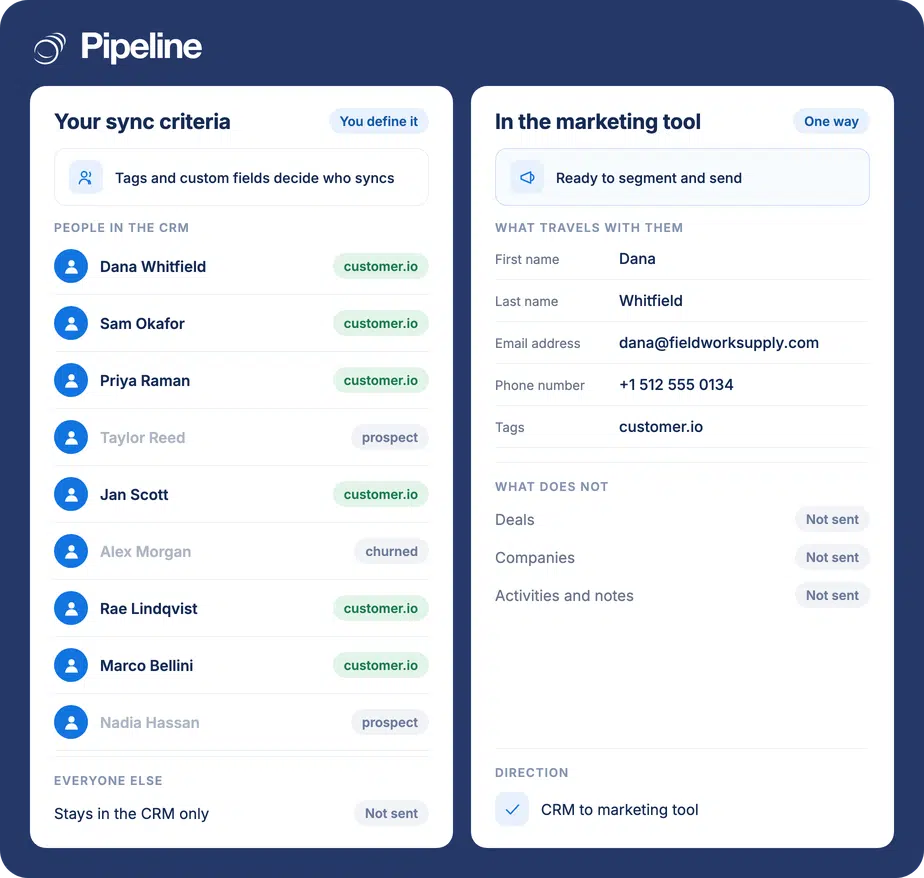
Pipeline CRM integrates with Customer.io through a built-in integration installed from the App Store and authenticated with a Customer.io API key. Contacts matching criteria you define, such as a tag or a custom field, sync from Pipeline CRM to Customer.io with their first name, last name, email address, phone number and tags. The sync runs one way, from Pipeline CRM to Customer.io.
The list export is where campaigns go wrong
Marketing needs a current audience. Handing it over as a spreadsheet makes that somebody’s recurring job, and an easy one to get wrong.
Exported lists are out of date on arrival
The CSV reflects the CRM at the moment it was pulled, and campaigns run for weeks after that.
The wrong people get the email
A churned customer or an unqualified lead left in the export lands in a campaign written for somebody else entirely.
Nobody can say who is in the audience
When membership is decided by whoever built the last spreadsheet, the answer to why someone received an email is a search through old files.
Two products, one token
Setup moves between both tools, so you need admin access to Pipeline CRM and admin permissions in Customer.io. Have your contact data in place first, since first name, last name, email and phone are what gets sent.
Install it in Pipeline CRM
Go to Settings, then Other, then App Store, search for Customer.io and click Install.
Create the source in Customer.io and copy the key
In Customer.io go to Data and Integrations, then Integrations, find the Customer.io API app, name it and copy the API key. Their own Pipelines API guide covers this side in full.
Paste the token, then set your criteria
Back in Pipeline CRM, paste the token into the Customer.io integration settings, save, and use Test Connection to check it. Enable it from the App Store, set your destination in Customer.io, then open the Criteria tab to choose which contacts sync. Full setup guide in the help centre.
Teams running lifecycle email off CRM data
This suits people whose campaign audiences are defined by something sales already records, rather than by a marketing list maintained separately.
Your segments come from sales data
If who should receive a campaign depends on a tag or field a rep sets, the CRM is the right place for that decision to live.
You want marketing out of the export business
Criteria replace the recurring request for a fresh list, and the audience keeps itself current.
You need to know why somebody was messaged
Membership traces back to a rule you can read, which matters when a customer asks why they received something.
In the Customer.io integration
Everything below is part of the integration, installed from the App Store.
Criteria-based syncing
Choose which contacts sync using tags, custom fields or other criteria rather than selecting people by hand.
Contact details sent automatically
First name, last name, email address and phone number travel with each matching contact.
Tags carried across
Tags used as sync criteria go with the contact, so you can segment on them in Customer.io.
Test Connection before enabling
Confirm the token works from inside Pipeline CRM before switching the integration on for the team.
An on and off switch
The integration is toggled from the App Store, so it can be paused without being uninstalled.
Installed from the App Store
It is built in and found under Settings, then Other, rather than being a third-party connector.
Your destination, your choice
Where the data lands is configured on the Customer.io side, so it fits the workspace you already run.
Criteria you can change later
The Criteria tab can be edited as your segmentation changes, without reconnecting anything.
People only, in one direction
This sends People from Pipeline CRM to Customer.io: first name, last name, email address, phone number and tags. Deals, companies, activities and notes stay in the CRM. Nothing comes back. Opens, clicks and campaign results live in Customer.io, so the CRM is where the audience is decided rather than where the engagement is read.
Customer.io integration questions
What people ask before syncing contacts out to marketing.
Does Pipeline CRM integrate with Customer.io?
Yes, and it is built in rather than a third-party connector. Install it from the Pipeline CRM App Store under Settings, then Other, and authenticate it with a Customer.io API key.
Once enabled, contacts matching the criteria you set sync from Pipeline CRM to Customer.io.
Which contacts get sent?
Only the ones matching the criteria you define on the Criteria tab, based on tags, custom fields or other conditions. Everyone else stays in the CRM.
A common setup is a single tag: tag a contact in Pipeline CRM and they appear in Customer.io according to your criteria settings.
What data actually travels?
First name, last name, email address, phone number, and tags when those tags are used as sync criteria.
Deals, companies, activities and notes are not sent. This is a contact sync for messaging, not a full record sync.
Where do I get the API key?
In Customer.io, go to Data and Integrations, then Integrations, and find the Customer.io API app. Name it and copy the API key it gives you.
That key goes into the Customer.io integration settings in Pipeline CRM, where Test Connection will confirm it works. Customer.io’s own Pipelines API guide documents their side, which is the version to trust as it changes.
Does campaign engagement come back into the CRM?
No. The sync runs one way, so opens, clicks and campaign results stay in Customer.io.
If you want engagement written back onto the contact record, that is a different arrangement and our Mailchimp integration works that way instead.
What do I need before starting?
Admin access to Pipeline CRM, a Customer.io account with admin permissions, and contact data in Pipeline CRM to send.
Setup crosses between the two products more than once, so it is easiest done in one sitting by somebody holding both sets of permissions.