

ActiveCampaign CRM integration, driven by your own criteria
Decide which contacts belong in ActiveCampaign, write that as a rule, and Pipeline CRM sends them across as they qualify. Their details stay current afterwards, so your segments are built on what the CRM knows rather than on a CSV from last quarter.
✓ No credit card required ✓ 14-day free trial ✓ Cancel anytime
Trusted by over 18,000 users globally





At a Glance
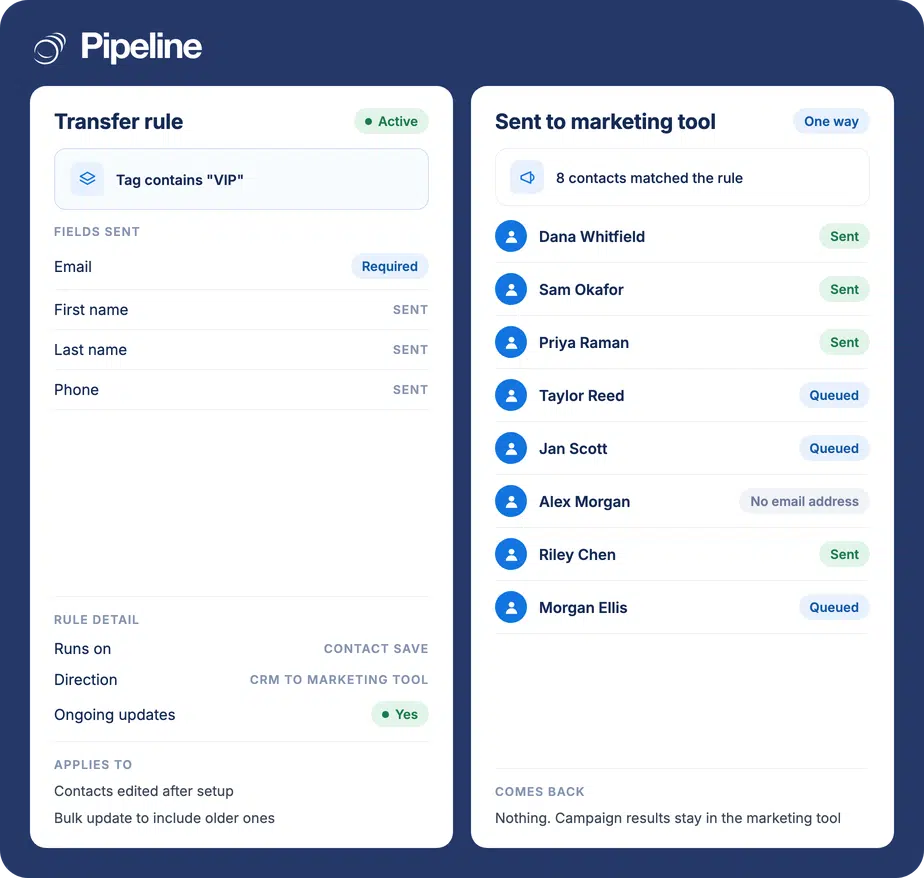
Pipeline CRM integrates with ActiveCampaign by sending contact records across on criteria you define, such as a tag containing a particular word. Four fields travel: first name, last name, email address and phone number. The transfer is one-way, from Pipeline CRM to ActiveCampaign, and only contacts modified after the integration is set up are included, so existing records need a bulk update to bring them across.
Segments are only as good as the data behind them
Marketing automation is precise about who gets what. That precision is wasted if the audience was assembled by hand.
The export is always out of date
A list pulled on Monday is missing everyone added since, and still contains the people who have moved on. Automation running on it inherits both problems.
Sales knowledge never reaches marketing
The rep knows which accounts are worth nurturing and which have gone cold. If that only lives in the CRM, campaigns cannot act on it.
Deciding who to include is a manual judgement
Someone eyeballs the CRM and picks. That does not scale, and it is not repeatable next month.
Connect ActiveCampaign in three steps
You need admin access to Pipeline CRM and an ActiveCampaign account with API access. Have your API URL and key to hand before you start.
Install and connect
Find ActiveCampaign in the App Store inside Pipeline CRM and install it, then paste in your ActiveCampaign API URL and API key.
Write the rule
Set the criteria that decide when a contact should transfer, for example a tag containing a particular word. Contacts need an email address to qualify.
Bulk-update your existing contacts
This step is easy to miss and matters. Only contacts modified after setup are sent, so bulk-update the records that already match your rule or nothing will happen to them.
ActiveCampaign transfer detail
Everything moves in one direction. Nothing comes back from ActiveCampaign into Pipeline CRM.
| What | Direction | Detail |
|---|---|---|
| Email address | Pipeline CRM to ActiveCampaign | Required. A contact with no email cannot transfer |
| First and last name | Pipeline CRM to ActiveCampaign | Available for personalisation |
| Phone number | Pipeline CRM to ActiveCampaign | Available as a field |
| Later edits to a contact | Pipeline CRM to ActiveCampaign | Changes keep flowing once the contact has transferred |
| Contacts that existed before setup | No | Not sent until they are modified. Bulk-update them to trigger it |
| Campaign opens, clicks and replies | No | Engagement data stays in ActiveCampaign |
| Deals and pipeline data | No | Only contact records transfer |
Teams running marketing automation next to a sales pipeline
This is for people who have already decided to keep both tools and want the handover to be automatic.
Teams with a real nurture programme
If ActiveCampaign is running multi-step automations, feeding it from the CRM keeps the entry conditions honest.
Anyone segmenting on sales signals
Tag a contact in the CRM based on what the rep knows, and the rule moves them into the right audience without a handover email.
Marketers tired of importing CSVs
The rule replaces the monthly export, which is usually the single most repetitive task in the marketing calendar.
In the ActiveCampaign integration
Everything below comes with the integration.
Criteria-based transfer
You define the rule that decides which contacts are sent.
Four contact fields
First name, last name, email address and phone number.
Ongoing updates
Once a contact has transferred, later changes in Pipeline CRM keep flowing across.
Tag-driven rules
Use a tag as the trigger, so a rep can move someone into a campaign audience from the record.
API key connection
Connect with your own ActiveCampaign API URL and key.
Bulk update to backfill
Bring pre-existing contacts across by updating them once.
Email-address validation
Contacts without an email are skipped rather than failing the transfer.
Admin-controlled setup
Configured once by an account admin rather than per user.
Existing contacts do not move until you touch them
This is worth reading twice, because it looks like a broken integration. Only contacts modified after you finish setup are sent to ActiveCampaign. So if you tag five hundred people, connect the integration, and wait, nothing happens – not because the rule is wrong but because none of those records have changed since. Bulk-update them once and they all qualify. After that the rule works on its own for everyone new.
ActiveCampaign integration questions
The things people ask before connecting the two.
How does the ActiveCampaign integration work?
You set criteria in Pipeline CRM that decide when a contact should be sent to ActiveCampaign, for example a tag containing a particular word. Contacts that match are transferred with their first name, last name, email address and phone number.
Once a contact has moved across, later edits in Pipeline CRM keep flowing to ActiveCampaign.
Why have my existing contacts not transferred?
Because only contacts modified after setup are included. Records that already matched your criteria before you connected the integration are not sent until something about them changes.
The fix is a one-off bulk update of those contacts, which makes them qualify. The setup guide covers it.
Is the sync one-way or two-way?
One-way. Pipeline CRM sends contact data to ActiveCampaign, and nothing comes back the other way.
That means campaign opens, clicks and replies stay in ActiveCampaign. If you want campaign engagement visible on the CRM record, the Mailchimp integration does return that data.
Which fields are sent?
Four: first name, last name, email address and phone number. The email address is required, so a contact without one will not transfer.
Deals, pipeline data and custom fields are not included.
What do I need before I start?
Admin access to Pipeline CRM, an ActiveCampaign account with API access, and your ActiveCampaign API URL and API key.
It is also worth checking your contact records have email addresses and the names are populated, since those are the fields the integration relies on.
Is ActiveCampaign a CRM?
It has CRM features. ActiveCampaign includes deals and pipelines, and for a team whose selling is largely driven by email automation that can be enough on its own.
Those features are built around the marketing automation rather than around the sales process, so teams that need deeper pipeline management, forecasting and activity tracking tend to run a dedicated CRM alongside it. That is the situation this integration is built for, rather than a reason to pick one over the other.
Can I trigger an ActiveCampaign automation from Pipeline CRM?
Not directly. The integration transfers contacts; it does not start automations from CRM events.
In practice you can get the same effect by having your transfer rule add contacts that an ActiveCampaign automation is already watching for, since a new contact arriving is something ActiveCampaign can act on itself.
Can I control exactly who gets sent?
Yes, that is the point of the criteria. You decide the condition, so you can keep the transfer narrow – a single tag, for instance – rather than pushing your whole contact list into a marketing platform.
Because a rep can apply the tag from the record, deciding who belongs in a campaign becomes part of normal CRM work instead of a separate request.