We’ve been testing and comparing two construction sales CRM heavyweights: Pipedrive vs. Salesforce. After careful research, we’ll be sharing everything we found and taking a closer look at two of the most popular sales-focused CRM products for contractors.
We’ll compare details like features, offerings, pricing, and support. By the end of this post, you should clearly understand what you’re getting into before choosing a sales CRM for builders.
Pipedrive CRM for Construction
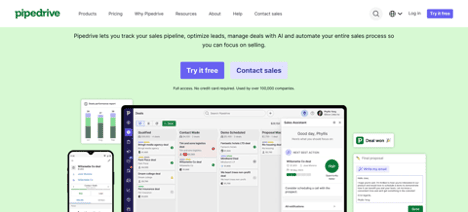
Pipedrive is a sales CRM designed to help businesses manage sales pipelines, track deals, and forecast revenue. While Pipedrive is not specifically built as a construction CRM, many construction companies use it to manage bids, proposals, subcontractor communication, and project-based sales processes.
Although its core focus is sales pipeline management rather than full project management, Pipedrive can support internal collaboration through activity tracking, shared deal notes, and workflow automation. For construction businesses looking for a CRM to manage job opportunities, Pipedrive offers a highly rated solution.
Pipedrive’s Best Features
- Lead generation with LeadBooster
LeadBooster (paid add-on) helps construction companies capture and source new leads. It includes access to a 400M+ contact database, chatbot and live chat for your website, and embeddable web forms to generate contractor and client inquiries.
- Email tracking and lead qualification
Track email opens and clicks to qualify leads and prioritize follow-ups. Route website chat inquiries to the right sales rep to respond faster to project requests and bid opportunities.
- Document management with Smart Docs
Send trackable quotes, proposals, and contracts directly from Pipedrive. Get notified when prospects open documents and request eSignatures to close construction deals faster. Smart Docs is included in higher-tier plans or available as a paid add-on.
- Construction-specific customization
Customize fields, pipelines, and workflows to track job types, project size, location, subcontractors, and multiple services. Pipedrive supports multiple currencies and languages, which is useful for regional and multilingual construction teams.
Pipedrive Limitations
- Key features locked behind add-ons
Several important tools require additional fees. LeadBooster (~$32.50/month), Smart Docs for proposals and contracts (~$32.50/month), and advanced email marketing features (~$13.33/month) are paid add-ons. If you add all three, that’s approximately $78.33 per month on top of your base CRM subscription, increasing the total CRM cost for contractors and builders.
- Limited features on entry-level plans
Lower-tier plans restrict reporting, automation, and advanced customization. For construction firms that rely on detailed sales forecasting, job pipeline reporting, or performance tracking, upgrades may be necessary.
- Integration and learning curve challenges
While integrations are available, setup can be complex. Teams without technical experience may face a learning curve when configuring workflows, automations, and custom fields for construction sales processes.
Pipedrive Support
- Tiered support model
Pipedrive offers support based on your pricing plan. Entry-level plans provide access to a chatbot and knowledge base only. - Live chat requires an upgrade
Live chat support is available starting on the Advanced plan, while 24/7 live chat support is included in the Power plan. There is no phone support on lower-tier plans. - Limited real-time help on basic plans
If your construction company needs hands-on onboarding, one-on-one assistance, or fast issue resolution, you’ll need a higher-tier subscription. For teams with limited technical experience, this may increase the overall cost of using Pipedrive as your construction CRM.
Here’s how one user described their experience with Pipedrive’s support during the trial period (source):
Signed up for a trial as I was interested in switching away from Hubspot. However when I signed up for a trial I was hoping to speak with someone over live chat to answer a few questions. They promote the live chat throughout their site, however their live chat is completely fake. It’s just a looping answer tree with an AI bot that does not allow you to speak to a real person. Spent 20 minutes trying different answers to see if I could actually speak with someone to answer my questions and had no luck.
Pipedrive Pricing Plans
- Essential: $24 per user/mo.
- Advanced: $44 per user/mo.
- Professional: $64 per user/mo.
- Power: $79 per user/mo.
- Enterprise: $129 per user/mo.
Salesforce for Construction
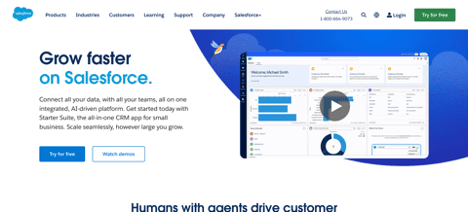
Salesforce is an enterprise CRM platform designed to manage complex sales processes, customer relationships, and revenue operations at scale. While Salesforce is not built specifically as a construction CRM, many large construction companies use it to manage bids, multi-project pipelines, subcontractor relationships, and long-term client accounts.
Its core strength lies in customization, automation, and advanced reporting rather than native construction project management. Through its AppExchange marketplace and integrations, Salesforce can connect with project management, ERP, and field service tools.
For construction firms that need enterprise-level CRM software with deep customization and scalability, Salesforce offers a powerful—though more complex—solution.
Here’s a glimpse into the Salesforce ecosystem:
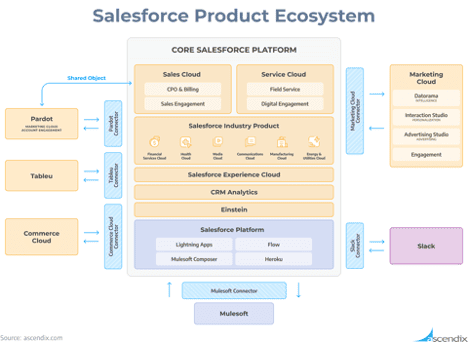
Source: ascendix.com
Salesforce’s Best Features
- Automated quotes and estimates
Create and manage quotes, pricing, discounts, and contract terms inside Salesforce. Track opportunities from bid to close and generate reports for revenue forecasting and pipeline management. - AI-powered forecasting with Salesforce Einstein
Salesforce Einstein uses AI and predictive analytics to score deals, forecast revenue, and surface insights. This supports data-driven decision-making for complex construction sales cycles. - Extensive app ecosystem (AppExchange)
Access thousands of integrations for ERP systems, accounting software, project management tools, and field service platforms. This allows construction firms to build a connected enterprise tech stack. - Field service management
Optimize scheduling, dispatch, and field team coordination with AI-powered tools. Manage technicians, subcontractors, and on-site operations more efficiently.
Salesforce Limitations
- High total cost of ownership
Salesforce licenses, add-ons, and AppExchange integrations are significantly more expensive than most CRM competitors. - Expensive and time-intensive implementation
Setup, customization, and onboarding can require significant investment, and time to ROI may be longer—especially for small to mid-sized construction firms. - Advanced features require higher-tier plans
Many AI, automation, and enterprise tools are only available on upgraded plans or as additional purchases, increasing overall CRM costs.
Salesforce Support
- Standard and paid support options
Salesforce provides support via phone, email, live chat, knowledge base, and Trailhead training. Enhanced support plans start at approximately $25 per user per month. - Premium support is significantly more expensive
Faster response times, priority case handling, and access to specialized teams require higher-tier plans, which can cost hundreds of dollars per user per month, increasing total CRM costs for construction companies.
Salesforce Pricing Plans
- Starter Suite: $25 per user/mo.
- Pro Suite: $100 per user/mo.
- Enterprise Suite: $165 per user/mo.
- Unlimited suite: $330 per user/mo.
- Einstein 1 Sales: $500 per user/mo.
Pipedrive vs. Salesforce CRM: Comparison of Construction Sales CRM Features
Here’s our head-to-head CRM comparison of Pipedrive and Salesforce for contractors.
| Pipedrive | Salesforce | |
| Multiple Pipelines | Yes | No (workaround available) |
| Custom Fields | Yes | Yes |
| Advanced Data Safeguards | Yes (policy) | Yes (defense in depth) |
| Lead Scoring | Built-in | Requires upgrade |
| Sales Automation | Included | Included |
| Team Activity Reporting | Included | Included |
| Email Drip Campaigns | Requires upgrade | Included |
| Mass Emails | Requires upgrade | Included |
| Email Tracking | Requires upgrade | Included (learn more) |
| Calling and SMS | Requires integrations | Limited/Requires integrations |
| Mobile CRM App | Included | Included |
| Quotes and Invoices | Upgrade required, Pipedrive adds watermarks to your docs. | Included |
| Popular Integration Options | Quickbooks, DocuSign, Google Apps, Slack, Zapier, Outlook, Twilio | 9,000+ via AppExchange |
Pipedrive CRM vs. Salesforce CRM: Which is the Better Choice for Construction Companies?
If you’re a small-to-medium company looking for a reliable CRM from a market leader, Pipedrive is the better fit. Their pricing isn’t out of reach for established companies, but you should still expect to pay extra for advanced features, services, and support.
If you’re an enterprise or medium-sized construction company working with large amounts of data, Salesforce is the better option. Larger companies can dedicate more resources to implementation. Bigger construction companies have developers, support teams, IT, and various other specialists at their disposal. They can hire the team they need to create, migrate, and manage their data.
Pipeline CRM: A Strong Alternative to Pipedrive and Salesforce for Construction Sales CRM
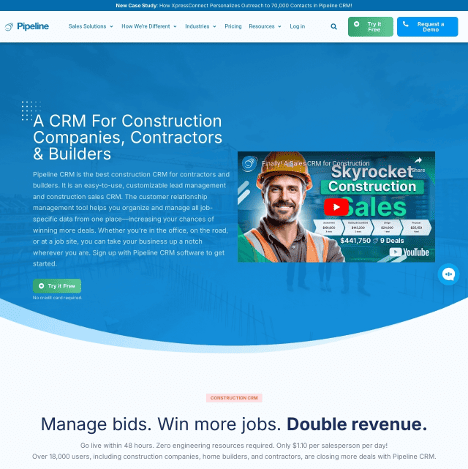
Pipeline CRM built its structure to align closely with how construction sales actually work.
Unlike Pipedrive, which is often optimized for fast, transactional sales pipelines, and Salesforce, which is mainly built for enterprise-level complexity, Pipeline CRM supports long, relationship-driven sales cycles with multiple stakeholders and proposal-based deals. That’s why many teams consider it the best construction CRM for contractors and builders who need stronger pipeline visibility without enterprise overhead.
If your construction company manages bids, tracks multiple decision-makers, sends proposals, and follows projects from first conversation to signed contract, Pipeline CRM fits that model naturally.
Why Pipeline CRM Suits Construction Sales
- Built for long, project-based sales cycles
Construction deals often last 3–6+ months and involve multiple conversations before a contract is signed. Pipeline CRM is designed for relationship-based selling, not high-volume transactional sales. According to our Pipeline CRM Performance Benchmark 2026, construction reps log an average of 0.22 activities per deal, indicating how much logging falls through the cracks when a CRM isn’t built for field use. - Track multiple contacts per deal
Each project may involve a general contractor, property owner, architect, estimator, and project manager. Pipeline allows you to manage multiple contacts under the same company and deal, giving full visibility into every stakeholder. - Flexible deal stages that match real construction workflows
Construction sales don’t follow generic pipelines. Customize deal stages to reflect your actual process—bid, estimating, awarded, contract signed, project in progress, and close-out. - Built-in proposals and eSignatures
Construction sales are proposal-driven. Pipeline includes proposal tracking and eSignatures without requiring expensive third-party add-ons, helping you close deals faster. - Document management for project-heavy workflows
Store estimates, permits, contracts, photos, and project notes directly within each deal, keeping job-specific information centralized.
Where Pipeline CRM May Not Be the Best Fit
Pipeline is a sales-driven and prospecting CRM. If your primary need is:
- Advanced analytical CRM functionality
- Deep internal collaboration tools
- Executive-level strategic dashboards
- Full-scale project management software
Then an enterprise or project-management-focused system may be a better fit.
Pipeline CRM Support
Pipeline CRM provides award-winning customer support across all plans, with unlimited chat and email support included by default. There are no paid support tiers, add-ons, or extended SLAs required to speak with a real person.
Our support team maintains a 97.6% customer satisfaction rate, with an average 1-minute chat response time, so construction teams can get immediate help when managing bids, proposals, and active deals.
When you need assistance, you won’t have to upgrade your plan or wait in long queues—we’re ready to help, as it should be.
Pipeline CRM Pricing Plans
- Start plan: $25 per user per month
- Develop plan: $33 per user per month
- Grow plan: $49 per user per month
- Enterprise plan: Custom
See what features included in each tier in our pricing plan.
Pipeline CRM offers three core paid plans plus a custom Enterprise option for larger construction teams. Pricing starts at $25 per user per month (billed annually), with higher tiers unlocking additional automation, customization, and reporting capabilities.
You can test the platform with a 14-day free trial before committing.
Compared to Pipedrive’s add-on-heavy pricing and Salesforce’s higher enterprise costs, Pipeline delivers advanced sales automation, proposal tracking, and customization at a more accessible price point for contractors and builders.
Pipeline CRM vs. Pipedrive vs. Salesforce for Managing Construction Sales Pipelines
| Feature / Criteria | Pipeline CRM | Pipedrive | Salesforce |
| Best for | Construction companies with long, project-based sales cycles | Transactional sales teams | Enterprise organizations with complex infrastructure |
| Sales Cycle Fit | Built for relationship-driven, multi-touch construction deals | Optimized for faster-moving sales pipelines | Designed for complex, enterprise-level sales processes |
| Multiple Contacts per Deal | Yes – manage multiple stakeholders within one deal | Limited depth for complex buying committees | Yes – highly customizable contact structures |
| Custom Deal Stages | Fully customizable (bid → estimating → awarded → close-out) | Customizable pipelines | Highly customizable but may require setup/configuration |
| Proposals & eSignatures | Built-in proposal tracking and eSign | Often requires paid add-ons (e.g., Smart Docs) | Available on higher-tier plans or via add-ons |
| Document Management | Store estimates, permits, contracts, notes within each deal | Available, some features gated by plan | Available through core features or integrations |
| Automation & Alerts | Built-in alerts for proposal views, milestones, deal updates | Strong automation tools | Advanced automation and AI (Einstein) |
| Implementation Complexity | Simple setup, faster adoption | Moderate | Complex, often requires implementation support |
| Support | Unlimited support included | Live support limited by plan | Paid support plans (starting ~$25/user/month; premium plans much higher) |
| Cost Structure | Scalable and affordable | Add-ons increase monthly costs | Higher total cost of ownership |
Pipeline CRM: The Best Sales CRM Alternative to Pipedrive CRM and Salesforce CRM
Choosing between Pipedrive, Salesforce, and Pipeline CRM comes down to sales complexity, budget, and how your construction deals actually move.
- Pipedrive works well for simple, transactional pipelines—but key features often require add-ons.
- Salesforce delivers enterprise power and deep customization—but at a significantly higher cost and implementation effort.
- Pipeline CRM is built for long, relationship-driven sales cycles with multiple stakeholders, proposal tracking, and customizable deal stages—without enterprise overhead.
I
f your construction company needs a CRM to manage bids, track decision-makers, centralize project documents, and close deals faster, Pipeline CRM offers a strong balance of functionality, simplicity, and affordability.
Ready to see how it works for your team?
Start a free trial of Pipeline CRM and experience a sales platform designed to help contractors and builders win more deals.
Pipedrive CRM vs. Salesforce CRM – FAQs
Here are some answers to common questions about Pipedrive, Salesforce, and Pipeline CRM.
What Should I Consider When Choosing a Construction Sales CRM for Small to Medium Businesses?
When choosing a construction sales CRM software, the following factors should be taken into consideration:
- Total cost of ownership: what the CRM offers, the add-on options, and the cost of upgrading to a higher tier when your construction business grows.
- Training and support needs: length of onboarding and need for team training to get started with the CRM.
- Mobile CRM: abilities to check and update deals after site visits.
- Sales automation workflow: easily set automation steps to help when new leads come in, changes in deal statuses, proposal is signed, etc. Must work on time and action-based triggers.
What’s the Best Construction Sales CRM Alternative to Pipedrive?
Pipeline CRM is a solid alternative to Pipedrive for construction sales CRM. In a head-to-head sales CRM comparison, Pipeline CRM offers everything you get with Pipedrive (and more) for less. There are no forced upgrades and no add-on avalanche. Unlimited support and all of the same features and tools you want.